ContentsFigures & Tables
The International Energy Agency (IEA) illustrated that we are still far from limiting global warming to 1.5 °C. The latest World Energy Outlook notes that reaching this goal is challenging. If current policies continue, the IEA predicts a 2.4 °C rise in temperature by 2100 [1]. This means governments must take urgent action to cut emissions significantly by 2030.
One of the most highly recommended approaches for reducing CO2 is carbon capture, utilisation, and storage (CCUS). Among the CCUS technologies, carbon capture (CC) is the central component [2]. Carbon capture can be applied to both the concentrated source and the atmosphere with the diverse design of the sorbents. Carbon capture has been researched widely; however, the current industry application is still limited, as amine-based capture is the dominant technology. Amine-based CC faces the challenges of high cost, large energy consumption, and environmental pollution [3]. More feasible CC technologies are expected.
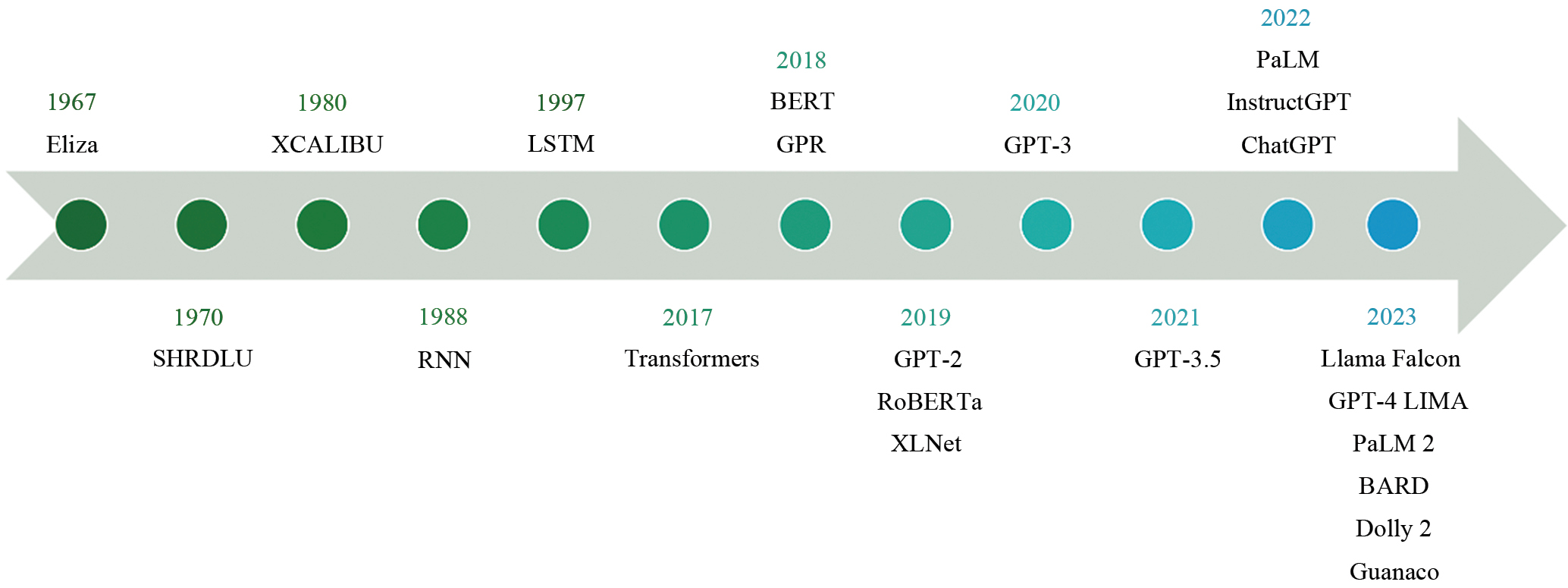
The application of artificial intelligence (AI) to carbon capture technology research can accelerate the discovery of new materials, optimize the process, and improve the system's efficiency, thus promoting the development of CC technology. Large language models (LLMs) have made significant progress in AI (Fig. 1) [4]. Trained on massive data, LLMs can understand and generate human language, demonstrating robust text analysis, knowledge reasoning, and cross-domain application capabilities. Its development can be traced back to early statistical language models, such as the n-gram model, which gradually evolved into neural network-based models, such as recurrent neural networks (RNN) and long short-term memory networks (LSTM). However, the real breakthrough occurred after the proposal of the Transformer architecture, which significantly improved the ability of models to process long text and complex language tasks through the self-attention mechanism [5]. The application scope of LLMs is rapidly expanding, from the initial text generation and machine translation, gradually penetrating scientific research, medical diagnosis, financial analysis, and other fields. For example, in biomedicine, LLMs are used for protein structure prediction and drug discovery [6]. In materials science, LLMs are used to accelerate the design and screening of new materials [7]. However, the rise of LLMs is accompanied by a number of challenges, such as raising concerns about their environmental impact [8], ethical and security concerns [9], and the limits of their use in mission-critical applications [10–13].
Due to the complex and time-consuming process of conventional material design and process optimization, LLMs can be supportive of reducing the time and cost of developing new materials and new technology, dependent on simulation, data-driven research approaches, knowledge integration, and decision-making etc. The paper highlights the novel application of LLMs in enhancing carbon capture technologies, focusing on material discovery, process optimization, and system integration by reviewing the up-to-date articles using LLMs on the CC technologies’ experiment design, optimization of the industry integration, and interpretation of sustainable information from a variety of sources. It also identifies key challenges such as data quality, model interpretability, and ethical considerations, proposing solutions to overcome these barriers for effective LLMs integration in carbon capture technologies. The paper outlines future research avenues, including developing domain-specific models, enhancing human-AI collaboration, and expanding applications to related fields like energy and transportation.
In 2018, OpenAI released the Generative Pre-trained Transformer (GPT) family of models that marked the beginning of the era of LLMs. GPT-2 and GPT-3 demonstrated excellent performance in tasks such as text generation, translation, and Q&A through large-scale pre-training and fine-tuning. On March 14, 2023, OpenAI launched its newest model, GPT-4, achieving high percentiles on the SAT and bar exams, excelling in LeetCode challenges, and providing contextual explanations for images, including niche jokes. Additionally, the report highlights how the model can be applied to chemistry-related problem-solving. Meanwhile, Google's bidirectional encoder representations from transformers (BERT) model further advanced language modeling through bidirectional contextual understanding [13]. The success of these models lies not only in their innovative technical architecture but also in their ability to learn rich linguistic and world knowledge from massive textual data.
LLMs are deep learning-based natural language processing (NLP) models trained on massive amounts of text data to understand and produce human language [14]. The fundamental of the LLMs is the Transformer architecture, which enables context-aware language modeling by capturing long-distance dependencies in text through a self-attentive mechanism. LLMs are trained to "predict the next word", requiring a large number of text inputs.
The goal of language modeling is to maximize the probability of the whole sequence when given a sequence of words x=(x1, x2, … xn):
That is: predict the probability of the current word. xt under the conditions given by the preceding words. The core steps in big language modeling include word embedding, transformer blocks (self-attention mechanism + feed-forward network), probability distribution of output words (Softmax), and output of the next word.
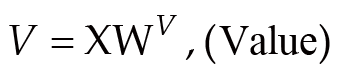
The process of converting input words into vectors is known as word embedding, which centres on mathematically mapping discrete text symbols into a continuous vector space so that semantically similar words are close to each other in the vector space. The specific steps include the following steps. First, vocabulary is constructed by mapping all possible words or subwords in the text to unique indices, typically based on word frequency in the training data. This results in a base word list that prioritizes high-frequency terms. Next, word vectors are initialized. Each word or subword is assigned to a unique integer index.
Embedding matrix: each word or subword corresponds to a unique integer index. The model maintains a matrix of dimension V × d, where V is the word list size and d is the embedding dimension. If the word index is i, its vector is the i-th row of the matrix:
The transformer model is the foundation of LLMs, and it consists of two key components.
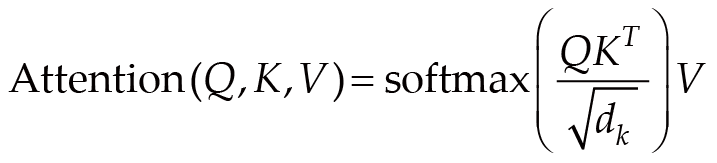
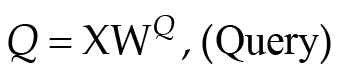
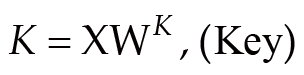
Self-attention: Self-attention allows the model to "pay attention" to information at other positions in the sequence when generating a word.
Among them:dk represents key vector dimension. This formula measures the "relevance" of different words and weights the sum according to this relevance.
Feed forward network (FFN): Each transformer layer also has a feed forward network:While the attentional mechanism retrieves information from earlier parts of the cue, the feed-forward layer allows the language model to "remember" information that does not appear in the cue. In fact, the feed-forward layer can be thought of as a database of information that the model has learned from the training data. The earlier feed-forward layers are more likely to encode simple facts related to specific words.
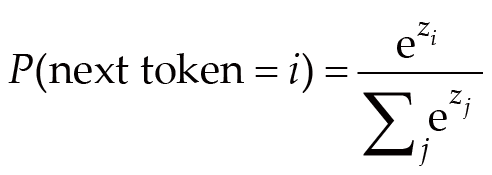
At the final layer of a language model, the network produces a vector of logits, z=[z1, z2, … , zV], where V is the size of the vocabulary. These logits are transformed into a probability distribution over the next possible tokens using the Softmax function:where, zi is the logit score for token i, V is the total number of tokens in the vocabulary, and is the normalization term that ensures all probabilities sum to 1.
This operation ensures that:
0<P(i)<1 for each token i.
ΣiP(i)=1, forming a valid probability distribution.
Prediction of the next word is according to the model based on a probability distribution. The LLM enables context-sensitive semantic modeling through the Transformer architecture and the self-attention mechanism. Its mathematical essence is a dynamic aggregation of global information through attention weights. Extract higher-order semantic features through multi-layer stacking. Learning a generic language representation through pre-training before migrating to downstream tasks.
The previous section reviewed the broad landscape of LLMs' integration into carbon capture technologies, highlighting their multifaceted applications in material discovery, process optimization, and sustainability analysis. Building upon this foundation, the following subsection delves more deeply into one specific and impactful application area: how LLMs, when combined with text mining techniques, are being leveraged to optimize carbon capture experiments. This transition from a general review to a focused exploration underscores the growing importance of data-driven knowledge extraction from scientific literature in advancing experimental methodologies. LLMs are being applied across carbon capture research and industry by optimizing experimental design through text mining, enhancing industrial process efficiency and decision-making, and enabling comprehensive analysis of sustainability data such as carbon footprints and market trends.
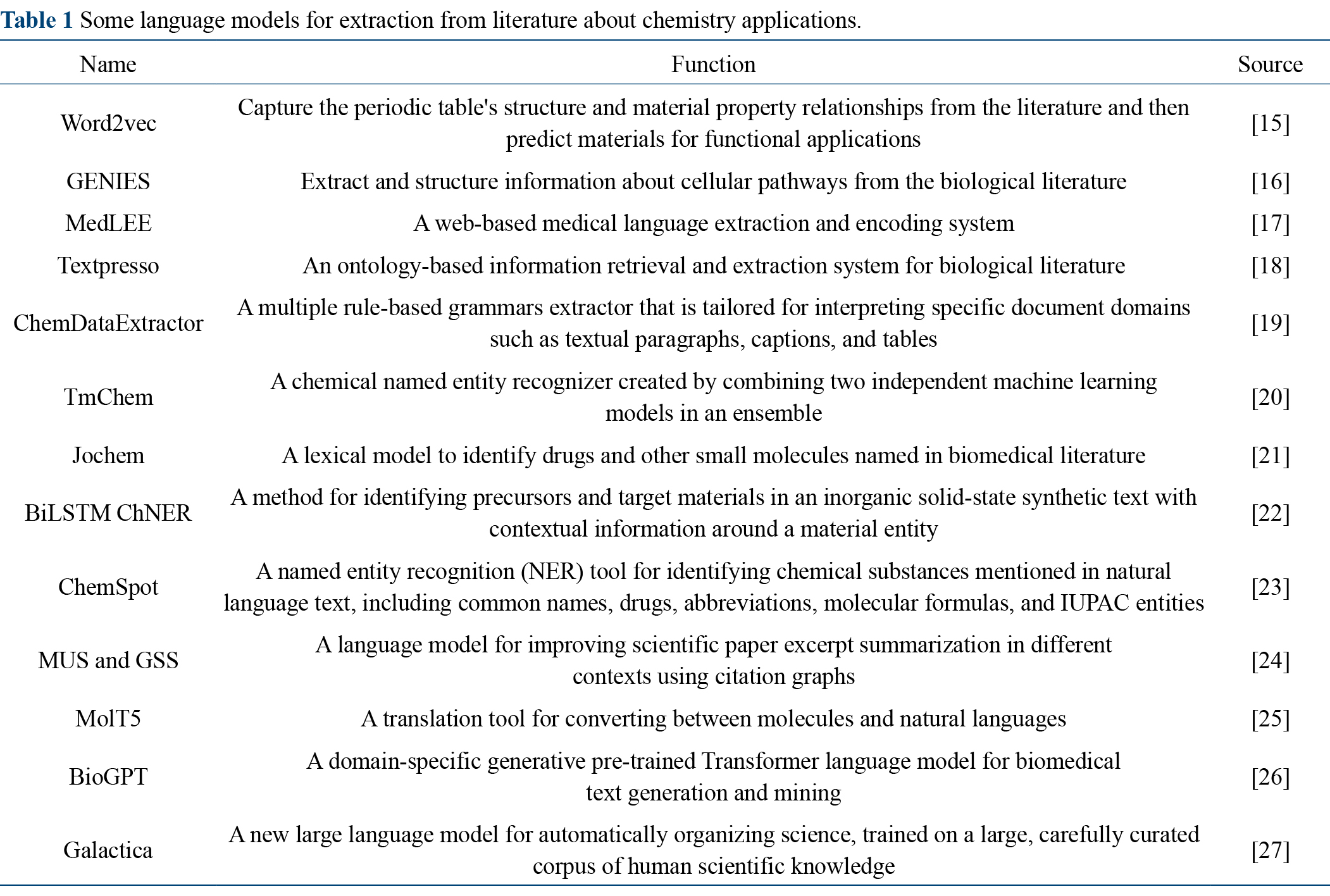
Most scientific achievement is published in text form, and the application of LLMs for extracting useful information from scientific literature, patents, and materials databases plays an important role in the development of carbon capture technologies. Despite the numerical data in the publication, there are valuable insights about the interpretation from the authors [15]. To increase the efficiency and accuracy of the extraction and analysis of this information, some studies have concentrated on utilizing supervised NLP techniques for retrieving information from the scientific literature. Table 1 shows an overview of some language models used to extract and analyze information from literature before the popularity of the LLMs, which eventually evolved to be used specifically for acquiring scientific knowledge. Most of the listed models in the table can also be applied to CC technology, which offers lots of chances for further research.
| Name | Function | Source |
|---|---|---|
| Word2vec | Capture the periodic table's structure and material property relationships from the literature and then predict materials for functional applications | [15] |
| GENIES | Extract and structure information about cellular pathways from the biological literature | [16] |
| MedLEE | A web-based medical language extraction and encoding system | [17] |
| Textpresso | An ontology-based information retrieval and extraction system for biological literature | [18] |
| ChemDataExtractor | A multiple rule-based grammars extractor that is tailored for interpreting specific document domains such as textual paragraphs, captions, and tables | [19] |
| TmChem | A chemical named entity recognizer created by combining two independent machine learning models in an ensemble | [20] |
| Jochem | A lexical model to identify drugs and other small molecules named in biomedical literature | [21] |
| BiLSTM ChNER | A method for identifying precursors and target materials in an inorganic solid-state synthetic text with contextual information around a material entity | [22] |
| ChemSpot | A named entity recognition (NER) tool for identifying chemical substances mentioned in natural language text, including common names, drugs, abbreviations, molecular formulas, and IUPAC entities | [23] |
| MUS and GSS | A language model for improving scientific paper excerpt summarization in different contexts using citation graphs | [24] |
| MolT5 | A translation tool for converting between molecules and natural languages | [25] |
| BioGPT | A domain-specific generative pre-trained Transformer language model for biomedical text generation and mining | [26] |
| Galactica | A new large language model for automatically organizing science, trained on a large, carefully curated corpus of human scientific knowledge | [27] |
Although lots of NLP models have been used in chemistry and materials areas, in terms of carbon capture technology and related research, the applications reported are very few. Metal-organic frameworks (MOFs) are a typical adsorbent for CO2 capture. With loads of lab-based work on MOFs, the current challenge of MOFs is the balanced properties (i.e., excellent gas selection, large sorption capacity, good stability, and low cost) when it is used as a CO2 adsorbent. Zheng et al. reported a novel ChatGPT-based system for text-mining-based synthesis conditions of MOFs, and training a model to predict reaction results [28]. This system is deployed to extract 26 257 distinct synthesis parameters, such as the materials' porosity, specific surface area, and adsorption properties, from around 800 MOFs in literature, which is a basis for screening materials with high CO2 adsorption capacity. An additional important innovation in this work is the contribution to the prediction of the synthesis of MOFs. However, this work only limits the prediction of crystalline powder or a single crystal. To support the development of AI in MOFs, machine learning (ML) is also an essential method. Another work is extended to explore a high-performance generative AI framework to generate synthesizable linkers with high CO2 adsorption capacity [29].
Prof. Dr. Omar M. Yaghi introduces an interaction framework of human-AI collaboration by integrating GPT-4 into reticular chemistry to guide the discovery of an isoreticular series of MOFs, with each synthesis fine-tuned. In this work, AI provides instructions for chemical experimentation, while human researchers offer feedback on the experimental outcomes. The operation of the approach does not require any coding skills, making it accessible to all chemists. This work presents potential for broader applications, including the CC technology based on MOFs [30].
Jami et al. proposed an LLM framework to extract knowledge and apply pretraining and transfer-learning techniques about carbon capture and utilization (CCU) from the Elsevier database via API [31]. A chatbot-like interface can respond to any query related to CCU using visual tasks. This work can help rapidly analyze the number of carbon capture and utilization applications.
With the LLM model, it is much easier to build a large database, and based on the database, it is possible to predict the target properties of a large number of new test structures. For example, Tshitoyan et al. show the possibility of extracting knowledge and relationships from a large amount of scientific literature using unsupervised language models and illustrate a general approach to mining scientific literature [15].
Most of the current carbon capture technologies are limited to low technology readiness level (TRL). Thus, the industry application of CC can be supported by LLMs. Apart from the text extraction for literature, other ML-assisted methods can help overcome the difficulty in predicting and facilitating the CC technology. As the carbon capture process involves chemical reactions and engineering parameters, LLMs can generate an optimization scheme to provide optimal mis-do parameters based on historical data and domain knowledge for the industry scale.
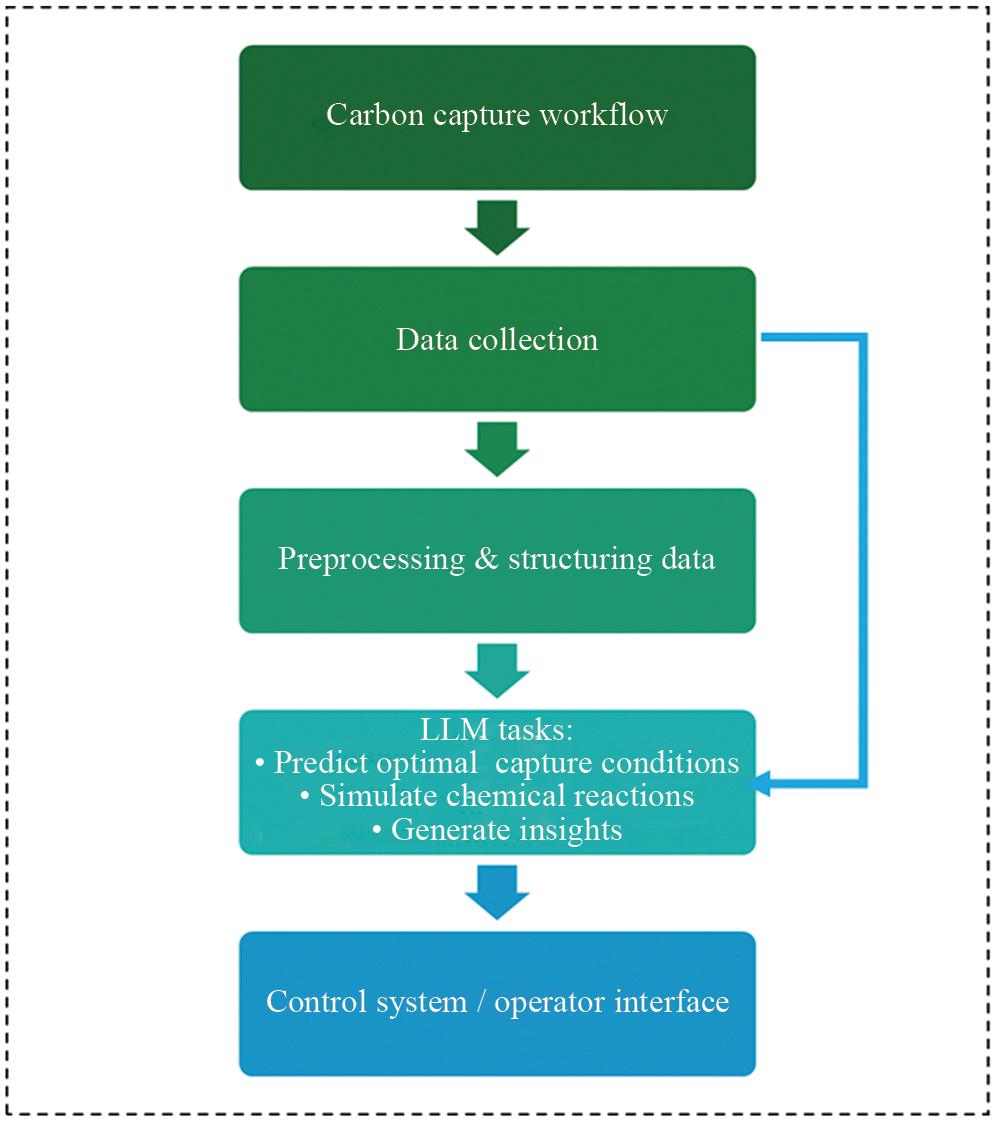
Integrating LLMs into carbon capture systems enhances efficiency, automation, and decision-making across the entire process. For example, Fig. 2 shows the carbon capture workflow. It begins with data collection from sensors and the internet of things (IoT) devices that monitor real-time variables such as temperature, pressure, and CO2 concentrations. This raw data is then preprocessed — cleaned, structured, and formatted — so the LLMs can effectively interpret it, which has been fine-tuned on domain-specific knowledge in environmental science and chemical engineering. Once the data is fed into the model, the LLMs perform various tasks: they predict optimal capture conditions, simulate chemical reactions, generate actionable insights, and forecast potential maintenance issues. These intelligent outputs are sent to control systems or operator interfaces, allowing for either human-in-the-loop decision-making or automated adjustments to the system's parameters. This forms a dynamic feedback loop where new data continuously informs the LLMs, enabling them to adapt and refine their predictions over time. The result is a more responsive, efficient, and explainable carbon capture process driven by AI.
Boiko et al. develop a multi-LLMs-based intelligent agent (Coscientist) to browse the internet and relevant documentation, use robotic experimentation APIs, and leverage other LLMs for various tasks, achieving six different tasks, such as planning chemical syntheses of known compounds using publicly available data, precisely controlling liquid-handling instruments through low-level instructions, solving optimization problems by analyzing previously collected experimental data [32]. This research demonstrates a promising example of advancing reasoning and experimental design when facing complex scientific problems. This kind of application can further benefit CC technologies as well.
Anyebe et al. use an AI-driven framework to optimize the effectiveness of the carbon capture process and improve maintenance practices in oil and gas facilities [33]. AI-driven solutions in this work can address critical challenges such as real-time monitoring and fault detection, optimizing system performance with greater efficiency. In addition, implementing AI-powered automation in industrial facilities also shows the potential to increase CO2 sequestration rates while minimizing operational disruptions, leading to a more effective carbon capture infrastructure. While it is centred on predictive maintenance, the data-driven approach described in this paper can be extended using LLM to interpret and synthesize the vast datasets and literature in the related field [34].
Gu et al. propose a rapid calculation paradigm, construction embodied carbon assessment (CECA), to estimate embodied carbon emissions in buildings [35]. The CECA methodology identifies the carbon contribution of various materials and components, facilitating carbon optimization in the building design process. The application of LLMs supports CECA's function of intelligent semantic parsing and automatically matches material and equipment information with corresponding carbon emission factors. This kind of research also appeals to other industries with carbon emissions, as assessing carbon emissions is also very important for carbon neutrality.
Another application of LLMs is to support decision-making in industry, especially manufacturing enterprises, by gaining a more comprehensive analysis throughout the production cycle [36]. The development and deployment of CC technologies require cross-disciplinary knowledge, such as chemistry, engineering, economics, business, and policy etc., and LLMs can provide a comprehensive assessment for the decision-making of CC technologies.
The aim of carbon neutrality for different industries can vary, affecting the whole business in return. Marco Wrzalik et al. exploit the application of LLMs in the carbon neutrality aim of different manufacturers, by proposing a two-stage emission information extraction tool (NetZeroFact) to select and collect emission information (specifically emission goals) from company reports. This tool is achieved by two steps, including the first step of filtering and retrieving potentially relevant paragraphs, and the second step of extracting structured information. From a dataset of more than 14 000 text paragraphs, 739 expert annotations were extracted, demonstrating the efficiency gains the proposed pipeline brings to human analysts [37].
Root cause analysis is a useful tool for industrial process mining and decision-making, which will benefit the identification and resolution of challenges in technology by contributing to the optimization of energy utilization, production efficiency, and quality improvement [38]. Tao Wu et al. introduced the ProcessCarbonAgent framework based on Root Cause Analysis to enhance the interaction capabilities of the decision-making process for high-carbon-emission states in industrial production. ProcessCarbonAgent can provide technical support for the low-carbon transition and intelligent upgrading of industrial processes through process data agents combined with predefined semantic text representations and process template prompting strategies; subsequently, self-information and LLMs are used to develop intent agents, which solve the context length limitation problem by identifying and eliminating redundancies [39].
Apart from the scientific literature, LLMs are also used to enhance sustainable details, such as carbon tax and carbon footprint, with accurate retrieval and analysis.
Carbon footprint is widely used in both technical and economic aspects. Wang et al. combined LLMs with retrieval-enhanced generation technology to retrieve carbon footprint information and subtle connections within unstructured real-time data sources, such as CFA standards, accounting methods, policy documents, industry processes, and technical literature on carbon emissions across various life cycle stages [40]. The proposed model, LLMs-RAG-CFA, can capture more relevant and specialized information with high accuracy. The LLMs-RAG-CFA has been applied in five industries, including primary aluminum, lithium battery, photovoltaic, new energy vehicle, and transformer, and it provided an efficient, reliable, and cost-saving solution for real-time carbon management.
Saikia et al. first proposed a semantic search to retrieve targeted information from video transcripts, business process data, and organizational insights [41]. This research bridges the gap between semantic search and robot-based question answering (QA) systems by combining video-recorded data with organizational and process data, thereby improving information retrieval in the petrochemical industry.
To boost carbon neutrality, Carbon Prices have been introduced in China and the European Union to form carbon markets, where emission allowances can be traded. Within the mechanism of the carbon market, the manufacturers need to reduce their emissions; otherwise, they need to purchase allowances from other manufacturers to cover their over-emission. To face this challenge, the industry needs to predict its emissions and the carbon price to have a balanced budget plan. Jiang et al. propose a time-series model (TSM) for initial prediction, followed by applying an LLM to predict the carbon markets of the Eu Emissions Trading System (EU ETS) and Chinese emission allowances [42]. They motivate LLMs to refine the time series model forecasts by showing LLMs a pair of past time series model forecasts and their corresponding real future prices as a chain of ideas. Chen et al. studied the impact of LLMs on forecasting China's carbon prices by processing a series of past and corresponding future prices as a chain of ideas [43]. In addition, LLMs are also used to analyze and classify the sentiment of news headlines and generate market sentiment labels to improve the forecast accuracy of LLMs. Incorporating news sentiment labels into LLMs can further reduce forecast bias, ranging from 3% to 4%. They also show that LLMs can improve the time series model forecasts for different regional markets by 28% to 38%.
The societal comprehension and acceptance of Net Zero technologies pose challenges and limitations to the development itself. LLMs can promote societal awareness and acceptance to support the achievement of carbon neutrality goals. Han et al. introduce an innovative framework that combines local knowledge with LLMs to significantly improve the depth, accuracy, and regional relevance of the information [44]. The effectiveness of the framework is examined from the perspectives of government, business, and community. Combining local knowledge with LLM not only enriches AI's understanding of regional characteristics but also ensures up-to-date information, which is essential for addressing specific concerns and questions about carbon neutrality raised by a wide range of stakeholders. Shan Shan continued social science research in Net Zero technology with LLMs, adopting a three-step causal inference model to identify socioeconomic factors of carbon emissions and climate change [45]. The approach starts with identifying correlations, then conducts causal analysis, and enhances decision-making capabilities through LLM-generated surveys in the context of climate change. The proposed framework provides adaptive solutions, supports climate-related data-driven policy-making and strategic decision-making, and reveals causal relationships within the field of climate change.
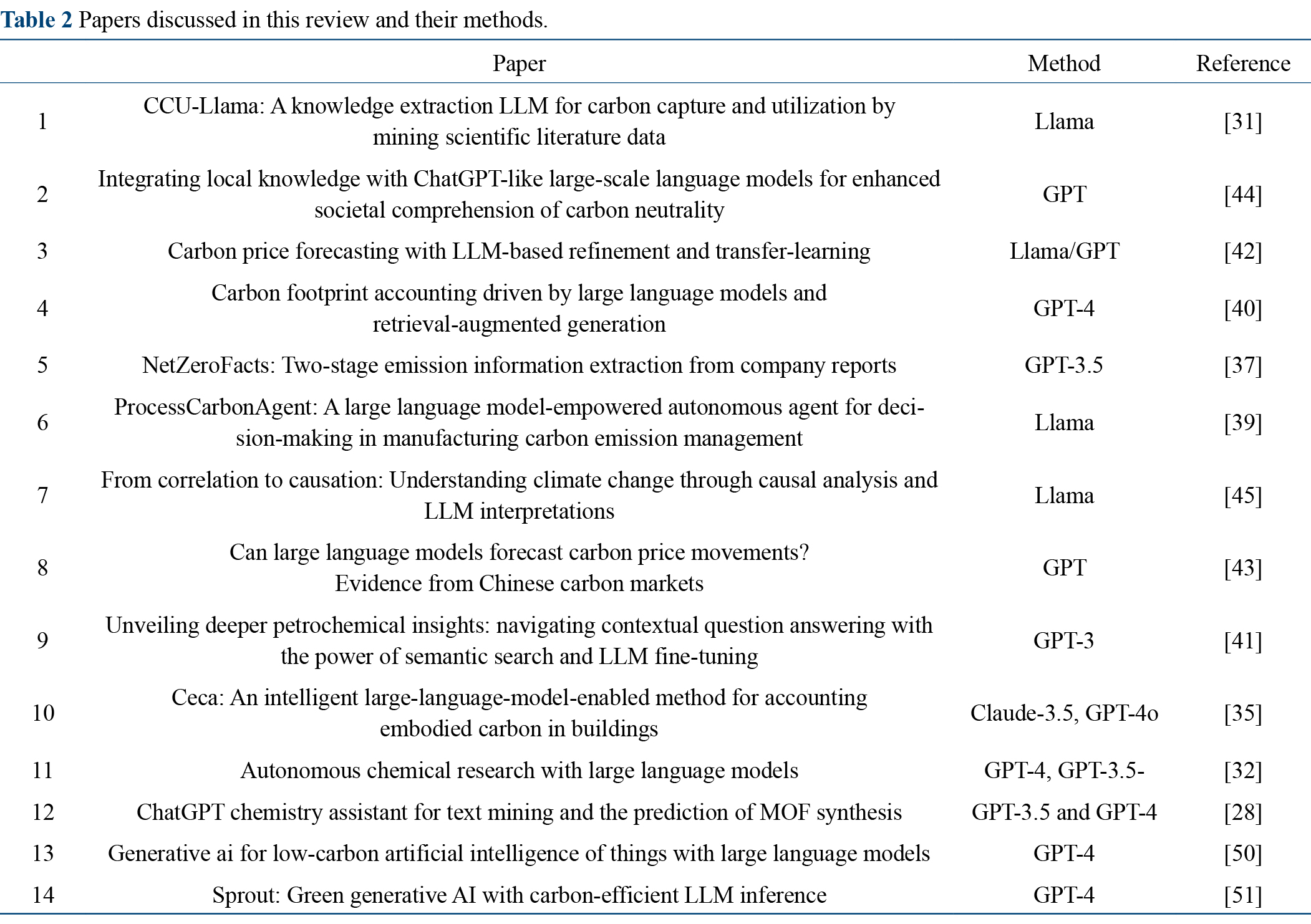
Table 2 includes all the work discussed in this review. Among 14 papers, 11 use ChatGPT. ChatGPT is the most popular method due to its efficiency when it is used to capture information and form a general explanation. The next chapter will illustrate the detailed comparison of models’ applications between ChatGPT and DeepSeek, Llama.
| Paper | Method | Reference | |
|---|---|---|---|
| 1 | CCU-Llama: A knowledge extraction LLM for carbon capture and utilization by mining scientific literature data | Llama | [31] |
| 2 | Integrating local knowledge with ChatGPT-like large-scale language models for enhanced societal comprehension of carbon neutrality | GPT | [44] |
| 3 | Carbon price forecasting with LLM-based refinement and transfer-learning | Llama/GPT | [42] |
| 4 | Carbon footprint accounting driven by large language models and retrieval-augmented generation | GPT-4 | [40] |
| 5 | NetZeroFacts: Two-stage emission information extraction from company reports | GPT-3.5 | [37] |
| 6 | ProcessCarbonAgent: A large language model-empowered autonomous agent for decision-making in manufacturing carbon emission management | Llama | [39] |
| 7 | From correlation to causation: Understanding climate change through causal analysis and LLM interpretations | Llama | [45] |
| 8 | Can large language models forecast carbon price movements? Evidence from Chinese carbon markets | GPT | [43] |
| 9 | Unveiling deeper petrochemical insights: navigating contextual question answering with the power of semantic search and LLM fine-tuning | GPT-3 | [41] |
| 10 | Ceca: An intelligent large-language-model-enabled method for accounting embodied carbon in buildings | Claude-3.5, GPT-4o | [35] |
| 11 | Autonomous chemical research with large language models | GPT-4, GPT-3.5- | [32] |
| 12 | ChatGPT chemistry assistant for text mining and the prediction of MOF synthesis | GPT-3.5 and GPT-4 | [28] |
| 13 | Generative ai for low-carbon artificial intelligence of things with large language models | GPT-4 | [50] |
| 14 | Sprout: Green generative AI with carbon-efficient LLM inference | GPT-4 | [51] |
While the preceding sections have demonstrated the promising applications of LLMs in various aspects of carbon capture, it is equally important to critically examine the challenges that may hinder their practical implementation. The following subsection begins this examination by addressing technical challenges, particularly those related to data quality, domain-specific adaptation, and model interpretability, which are fundamental to ensuring the reliable and effective integration of LLMs into carbon capture technologies.
The first and most important challenge is data quality and availability. LLMs are often trained on data from generic domains and lack chemical domain expertise, resulting in a limited understanding of chemical concepts, terminology, and processes. Research data in the field of carbon capture is often fragmented, incomplete, and lacks a degree of standardization, e.g., variability in the structure of experimental data, and differences in image representation. This limits the cultivation and application of LLMs.
The second issue is the interpretability and reliability of the models. The "black box" nature of LLMs makes it difficult to interpret the prediction results, especially in the application of carbon capture engineering, which involves a chemical engineering process, related to safety and economy [46].
In addition, LLMs need to be fine-tuned and optimized for the carbon capture sector to improve the expertise and accuracy of the model. This will require more support from expert human resources, as the experience of experts is also valuable in this field, especially the engineering aspect. The interactive method has also been used to fill this gap between AI and human resources, and more work is expected in the future. For example, Park and Yang experimented with fusing mapping and AI to predict carbon emissions from physical assets in a case study in Jeonju, South Korea. The prediction of carbon emissions in hotspot areas was implemented to point the way for urban management systems [47].
Subsequently, the current software related to chemical engineering/chemistry/materials often has complex user interfaces and proprietary data formats, which make it difficult for LLMs to interact directly with them. Therefore, additional interface development and adaptation work will be required.
While LLMs present transformative potential across scientific and industrial domains, their development and deployment raise significant concerns regarding environmental sustainability. The development of LLMs is computationally intensive, typically requiring significant energy consumption, resulting in carbon emissions. Hardware such as graphics processing units (GPUs), tensor processing units (TPUs), and supercomputers leads to large quantities of electricity [48].
One of the most critical issues is the carbon footprint associated with training and operating LLMs, which stems from the intensive energy consumption required to process massive datasets using high-performance computing infrastructure. Training a single LLM can consume hundreds of megawatt-hours (MW·h) of electricity. For instance, training GPT-3 was estimated to consume approximately 1287 MW·h of electricity, resulting in over 550 metric tons of CO2 emissions—roughly equivalent to the annual emissions of 120 U.S. passenger vehicles [49, 50].
Several studies have raised alarms regarding the unsustainable growth of AI, suggesting a need for new benchmarks not only for model performance but also for energy efficiency and emissions per task (e.g., energy use per 1000 inferences). Initiatives like Green AI and Carbontracker aim to bring transparency to AI energy usage and promote greener practices [51].
To address this environmental challenge, researchers are exploring strategies to reduce the carbon footprint of LLMs' training and deployment while integrating carbon capture techniques. One approach is to optimize the energy efficiency of the hardware infrastructure, for example, by using dedicated AI accelerators (e.g., TPUs or GPUs) with lower power consumption and higher computational throughput. In addition, leveraging renewable energy sources in data centres can significantly reduce the carbon intensity of LLM training. Recent research has also proposed algorithmic innovations such as sparse training techniques and model refinement to reduce the computational resources required without compromising model performance. In addition, integrating carbon capture and storage (CCS) technologies into data centre operations is emerging as a promising solution. For example, direct air capture (DAC) systems can be deployed to offset emissions from LLM development. By combining energy-efficient computing, renewable energy, and carbon capture technologies, the AI research community can mitigate the environmental impact of LLM development and contribute to global carbon neutrality goals. Future research should focus on quantifying the life cycle carbon emissions of LLM and developing a standardized framework for sustainable AI development.
In the paper by Jiang et al., the energy consumption and carbon emission impacts of eight major stages discussed throughout the life cycle of intelligent chatbots are elucidated and highlighted [52]. Based on a life cycle and interaction analysis of these stages, three strategic pathways are proposed to optimize the management and mitigate the associated footprint, which implies the requirement for the lifecycle energy use and carbon emissions from the LLM-driven intelligent chatbot industry.
In the work of Wen et al., an LLMs-enabled framework including pluggable LLM and Retrieval Augmented Generation (RAG) modules is proposed to reduce carbon emissions of the IoT [53]. Despite the case study on the optimization of carbon emission for mobile AI-generated content (AIGC) task, the author mentions the future directions in this area, including the carbon emission minimization problems for cloud-edge device architectures, generative AI-enabled carbon trading through the agent and training optimization for generative AI models.
Baolin Li et al. report a framework, Sprout, used for the carbon reduction in the LLMs’ inference [54]. By employing a strategy optimizer for instruction assignment and a novel offline quality assessor, sprout reduces the carbon footprint of generative LLM inference by over 40% in real-world assessments, utilizing the Llama model and global grid data.
Lawie compare the carbon emissions produced by the 16 largest AI systems, including GPT-3 and GPT-4 from Open AI, LaMDA, Bard, BERT, PaLM, Mt5 from Google, Gopher, AjphaFold, Gato, Chinchilla, Sparrow from DeepMind, Llama, ESMFold, OPT-IML, and BlenderBot-3 from Meta [55]. A key aspect of this assessment is to compare AI emissions with total carbon dioxide emissions from industry and fossil fuel use, ultimately determining that the top 16 AI systems have a very small impact on global warming, with the benefits outweighing the drawbacks. However, with the boosting development of AI systems, this impact should also be evaluated and considered.
Computational resource requirements and costs are also constraints. The training and application of LLMs require a large amount of computational resources, which may increase the overall cost of carbon capture technologies. Unlike training, inference is a continuous activity. With the growing use of LLM-based applications like ChatGPT, Bing Chat, or enterprise AI tools, inference can outweigh initial training costs over time. Moreover, hardware requirements are another major challenge. LLMs demand large clusters of GPUs or TPUs that are not only expensive but also have a high embodied cost due to the manufacturing and cooling infrastructure required in data centers. Data centers globally now account for about 1%–1.5% of total electricity use, a figure expected to increase with expanding AI workloads [56].
The ethical and safety issues cannot be ignored. LLMs might be misused to design harmful materials or optimize high-carbon-emission processes, which is contrary to the original purpose of carbon capture technology. Therefore, appropriate ethical guidelines and safety regulators need to be established to ensure the benign development of technology.
Applying LLMs in carbon capture technologies provides a new path to address climate change. The application of LLMs in carbon capture technologies is promising but still needs further exploration and optimization. The following are several key directions for future development:
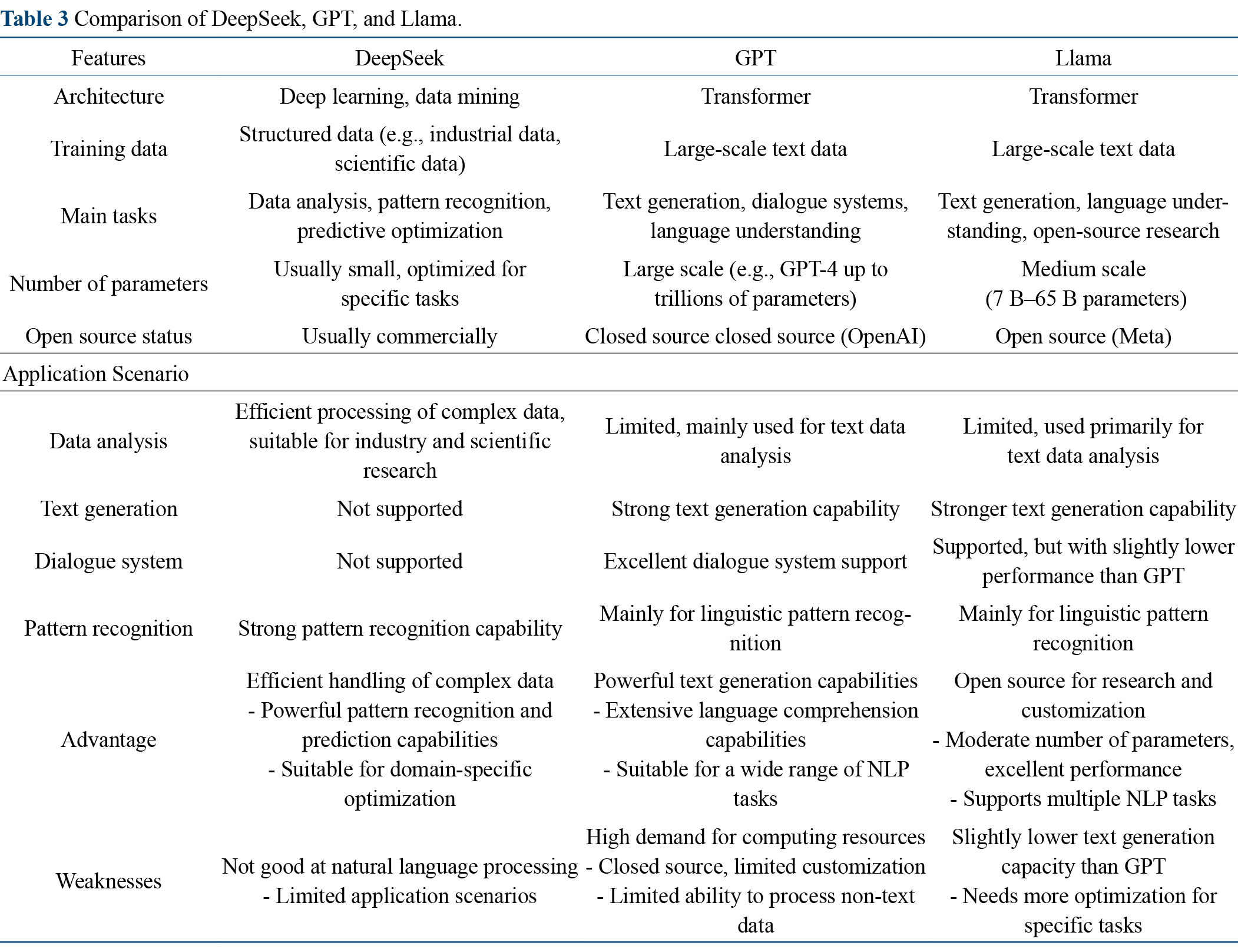
For incorporating LLMs into scientific research on carbon capture, GPT-4 and Llama are currently used as the main choices for LLM Table 2. The advantages and disadvantages of some of the main current large language models are shown in Table 3. Among them, DeepSeek may have more in-depth knowledge and more specialized answering capabilities within a specific domain or industry, especially in the domain it is trained to optimize. At the same time, DeepSeek may be more competitive in terms of cost, providing a more economical solution for small and medium-sized enterprises (SMEs) or individual users. Therefore, the improvement of LLM applications in CC technologies needs to focus more on parameter fine-tuning and arithmetic enhancement. Combining algorithms with specific data structures can help improve algorithmic accuracy and save computational resources. In addition, it is expected that more feature-specific LLMs (e.g., DeepSeek) will be used for further optimization of structured data in the specific field of carbon capture [57].
The application of LLMs (e.g. GPT-4, Llama, etc.) in programming and office software has made significant progress and can significantly improve development efficiency and office automation. The integration and support of LLMs with external software is in a rapid development stage. In the case of ChatGPT, for example, OpenAI has introduced an ecosystem of plug-ins that enable it to call external APIs, access real-time information, perform web browsing, run code, and more. This capability allows models to interact directly with other software and services beyond the confines of plain text generation, providing more accurate, real-time data support and decision-making recommendations.
Studies such as Toolformer: language models can teach themselves to use tools demonstrate that LLMs automatically learn how to invoke external tools (i.e., calculators, search engines, databases, etc.) through self-supervised learning [58]. This provides a new way for models to extend their capabilities, enabling them to perform complex tasks more efficiently.
Projects such as LangChain [59] and other open-source frameworks have demonstrated in practice that it is possible to seamlessly integrate LLMs with external data sources, computational services, and specialized software by building a complete set of tool chains and workflows. This not only supports the convergence of cross-domain knowledge but also provides reliable technical support for industry-level applications (e.g., data integration and analysis for carbon capture technologies).
With the help of external software and services, LLMs provide real-time access to the latest market, policy and technology developments, thus providing decision-makers with cutting-edge integrated analyses and strategic recommendations. It is particularly important for the assessment and deployment of interdisciplinary, complex technological systems such as carbon capture technologies. For example, the development of programs that use large language models can help manipulate related software such as Aspen and Comsol.
Current LLMs are mainly based on textual data, while the research of carbon capture technologies involves a variety of data types, including experimental data, images, molecular structure diagrams, and engineering drawings. One of the future directions is to develop multimodal big models that can handle text, image, video, and structured data simultaneously. For example, OpenAI's CLIP [60, 61] and DALL-E models have demonstrated the potential of combining text and images [62, 63]. In the field of carbon capture, multimodal models can be used for:
Molecular structure analysis: Combining textual descriptions and molecular images to predict the adsorption properties of materials.
Experimental data integration: Combining experimental records with images of experimental results to automatically generate experimental reports.
Engineering design and optimization: Proposing design improvements by analyzing engineering drawings and text descriptions.
Although the general-purpose LLMs perform well in several domains, there is still room for improving their performance in specialized domains such as carbon capture. Future research could focus on training domain-specific LLMs, such as dedicated models for carbon capture materials, chemical reactions or engineering optimization. These models can be realized by:
Pre-training with domain data: Pre-training using scientific literature, experimental data and patents in the field of carbon capture.
Fine-tuning and transfer learning: Based on the generic model, fine-tuning is performed using domain data to improve its specialized performance.
Knowledge graph combination: Combining the large language model with the knowledge graph of the carbon capture domain to enhance its reasoning capability.
Although the generative power of large language models is powerful, their outputs still need to be verified and optimized by human experts. Understanding and targeting improvements to the LLMs "black box" analysis process, particularly in the context of CC experts' background knowledge. Future human-computer collaboration platforms can combine LLMs' automation capabilities with human experts' judgment to achieve a more efficient research workflow. Example:
Intelligent assistants: Developing scientific research assistants based on large language models to help researchers quickly generate experimental protocols, analyze data, and write papers.
Collaboration tools: Building a platform that supports multi-user collaboration to promote knowledge sharing and collaborative innovation among research teams.
Real-time feedback mechanism: Through human-computer interaction, optimize the output results of the model in real time to improve its accuracy and practicality.
With the increasing application of LLMs in scientific research, their ethical and safety issues have attracted much attention. Future research needs to develop clear application specifications to ensure that the output results of the models are reliable and ethical. Specific measures include:
Transparency and interpretability: Developing an interpretable model architecture that makes the model's decision-making process transparent.
Data privacy protection: Ensuring the privacy and security of training data and usage data to prevent sensitive information leakage.
Fairness and bias control: Avoiding bias in the model's data training and application process, and ensuring the fairness of its output results.
The training and deployment of LLMs consume a large amount of computational resources, which burdens the environment. For example, DeepSeek has a clear advantage over computational costs. Future research can explore more efficient computational methods and green AI techniques, such as:
Model compression and optimization: Reducing the computational resource requirements of models through techniques such as model pruning, quantization, and knowledge distillation.
Distributed computing: Decreasing the energy consumption of models using distributed computing and edge computing techniques.
Sustainable AI: Developing renewable energy-based computing infrastructure to reduce the carbon footprint of AI technologies
Carbon capture technology involves multiple discip-lines such as chemistry, materials science, environmental engineering, and economics. Future research could further advance the application of LLMs in cross-disciplinary integration, for example:
Cross-disciplinary knowledge integration: Integrating knowledge from different disciplines into a large language model to provide a more comprehensive solution.
Policy and economic analyses: Combining economics and policy studies to assess the feasibility and social impacts of carbon capture technologies.
Education and popularisation of science: Using the large language model to generate interdisciplinary science content to enhance public awareness of carbon capture technology.
The Net Zero Energy sector plays a pivotal role in achieving carbon neutrality as human beings’ activities rely on services powered by a variety of energy. Global energy demand is projected to increase significantly over the coming century, even with substantial efficiency improvements [64]. The transportation sector, which is both the largest emitter of carbon globally and the fastest-growing contributor to carbon emissions, presents a critical challenge. In addition to decarbonizing the energy supply (generation), reducing emissions from the transport and industrial sectors will be essential in reaching global net-zero goals [65]. Some research has focused on Intelligent Transportation using LLMs (i.e. intelligent real-time traffic analytics framework for efficient customized transportation surveillance and management [66]). In terms of carbon neutrality in transportation, LLMs have not been widely used to integrate net-zero technologies into transportation. Thus, it will be promising to be a typical and beneficial scenario.
This review has examined the current applications and future potential of LLMs in advancing carbon capture technologies. Key findings include:
(1) LLMs are being successfully applied to extract knowledge from scientific literature, optimize experimental design and processes, and support decision-making in carbon capture research and implementation.
(2) Integrating LLMs with carbon capture enables more efficient materials discovery, process optimization, and system integration across the technology lifecycle.
(3) LLMs are enhancing sustainable information retrieval and analysis related to carbon pricing, footprints, and societal impacts of carbon capture.
(4) Challenges remain around data quality, model interpretability, carbon emissions, computational costs, and ethical considerations.
(5) Future directions include developing domain-specific models, improving human-AI collaboration, enhancing multimodal capabilities, and expanding applications to related fields like energy and transportation.
In conclusion, while still an emerging area, LLMs demonstrate significant promise in accelerating carbon capture innovation and deployment to accelerate decarbonization technology development. Realizing this potential will require continued interdisciplinary collaboration between AI researchers, domain experts, policymakers, and industry. With further advances, LLMs could play a pivotal role in optimizing carbon capture development to support the transition to a low-carbon future in engineering, transportation, and energy fields.
We appreciate the Shenzhen Polytechnic Research Fund (No. 6023310023K) and the Science and Technology Project of Henan Province (No. 252102230120) for their financial support. Thanks for Mr Bei XUE'S support in this work.
International Energy Agency, World Energy Outlook 2024, 2024, Accessed: 20 March 2025 [online]. Available: https://www.cleanenergyministerial.org/resource-cesc/world-energy-outlook-2024/.
A. G. Olabi, T. Wilberforce, K. Elsaid, E. T. Sayed, H. M. Maghrabie, and M. A. Abdelkareem, "Large scale application of carbon capture to processing industries–a review," Journal of Cleaner Production, vol. 362, p. 132300, 2022.
S. Talei, D. Fozer, P. S. Varbanov, A. Szanyi, A. Szanyi, and P. Mizsey, "Oxyfuel combustion makes carbon capture more efficient," ACS Omega, vol. 9, no. 3, pp. 3250–3261, 2024.
R. Tiwari, "Building large language models from scratch: Initial guide, medium," Accessed: 5 March 2025[online]. Available: https://medium.com/@AI-Simplified/building-large-language-models-from-scratch-a-beginners-guide-d464e54f932b.
P. Shaw, J. Uszkoreit, and A. Vaswani, "Self-attention with relative position representations," arXiv preprint arXiv:1803.02155, 2018.
J. Jumper, R. Evans, A. Pritzel, T. Green, M. Figurnov, O. Ronneberger, K. Tunyasuvunakool, R. Bates, A. Žídek, A. Potapenko et al., "Highly accurate protein structure prediction with AlphaFold," Nature, vol. 596, no. 7873, pp. 583–589, 2021.
O. Kononova, H. Huo, T. He, Z. Rong, T. Botari, W. Sun, V. Tshitoyan, and G. Ceder, "Text-mined dataset of inorganic materials synthesis recipes," Scientific Data, vol. 6, no. 1, p. 203, 2019.
S. Mysore, Z. Jensen, E. Kim, K. Huang, H.-S. Chang, E. Strubell, J. Flanigan, A. McCallum, and E. Olivetti, "The materials science procedural text corpus: Annotating materials synthesis procedures with shallow semantic structures," arXiv preprint arXiv:1905.06939, 2019.
B. J. Bender, S. Gahbauer, A. Luttens, J. Lyu, C. M. Webb, R. M. Stein, E. A. Fink, T. E. Balius, J. Carlsson et al., "A practical guide to large-scale docking," Nature Protocols, vol. 16, no. 10, pp. 4799–4832, 2021.
C. Rudin, "Stop explaining black box machine learning models for high stakes decisions and use interpretable models instead," Nature Machine Intelligence, vol. 1, no. 5, pp. 206–215, 2019.
Y. Xue, C. Kambhampati, Y. Cheng, N. Mishra, N. Wulandhari, and P. Deutz, "A LDA-based social media data mining framework for plastic circular economy," International Journal of Computational Intelligence Systems, vol. 17, no. 1, p. 8, 2024.
A. Radford, J. Wu, R. Child, D. Luan, D. Amodei, and I. Sutskever, "Language models are unsupervised multitask learners," OpenAI Blog, vol. 1, no. 8, p. 9, 2019.
S. Alaparthi and M. Mishra, "Bidirectional encoder representations from transformers (BERT): A sentiment analysis odyssey," arXiv preprint arXiv:2007.01127, 2020.
J. Devlin, M.-W. Chang, K. Lee, and K. Toutanova, "BERT: Pre-training of deep bidirectional transformers for language understanding," Proceedings of the 2019 Conference of the North American chapter of the Association for Computational Linguistics: Human Language Technologies, vol. 1, pp. 4171–4186, 2019.
V. Tshitoyan, J. Dagdelen, L. Weston, A. Dunn, Z. Rong, O. Kononova, K. A. Persson, G. Ceder, and A. Jain, "Unsupervised word embeddings capture latent knowledge from materials science literature," Nature, vol. 571, no. 7763, pp. 95–98, 2019.
C. Friedman, P. Kra, H. Yu, M. Krauthammer, and A. Rzhetsky, "GENIES: A natural-language processing system for the extraction of molecular pathways from journal articles," Bioinformatics, vol. 17, issue suppl_1, pp. 74–82, 2001.
C. Friedman, L. Shagina, S. A. Socratous, and X. Zeng, "A WEB-based version of MedLEE: A medical language extraction and encoding system," in AMIA Annual Fall Symposium Proceedings, Washington, DC, USA, 26–30 October 1996, p. 938.
H.-M. Müller, E. E. Kenny, and P. W. Sternberg, "Textpresso: an ontology-based information retrieval and extraction system for biological literature," PLoS Biology, vol. 2, no. 11, p. e309, 2004.
M. C. Swain and J. M. Cole, "ChemDataExtractor: A toolkit for automated extraction of chemical information from the scientific literature," Journal of Chemical Information and Modeling, vol. 56, no. 10, pp. 1894–1904, 2016.
R. Leaman, C.-H. Wei, and Z. Lu, "TmChem: A high performance approach for chemical named entity recognition and normalization," Journal of Cheminformatics, vol. 7, pp. 1–10, 2015.
K. M. Hettne, R. H. Stierum, M. J. Schuemie, P. J. M. Hendriksen, B. J. A. Schijvenaars, E. M. van Mulligen, J. Kleinjans, and J. A. Kors, "A dictionary to identify small molecules and drugs in free text," Bioinformatics, vol. 25, no. 22, pp. 2983–2991, 2009.
T. He, W. Sun, H. Huo, O. Kononova, Z. Rong, V. Tshitoyan, T. Botari, and G. Ceder, "Similarity of precursors in solid-state synthesis as text-mined from scientific literature," Chemistry of Materials, vol. 32, no. 18, pp. 7861–7873, 2020.
T. Rocktäschel, M. Weidlich, and U. Leser, "ChemSpot: A hybrid system for chemical named entity recognition," Bioinformatics, vol. 28, no. 12, pp. 1633–1640, 2012.
X. Chen, M. Li, S. Gao, R. Yan, X. Gao, and X. Zhang, "Scientific paper extractive summarization enhanced by citation graphs," arXiv preprint arXiv:2212.04214, 2022.
C. Edwards, T. Lai, K. Ros, G. Honke, K. Cho, and H. Ji, "Translation between molecules and natural language," arXiv preprint arXiv:2204.11817, 2022.
R. Luo, L. Sun, Y. Xia, T. Qin, S. Zhang, H. Poon, and T.-Y. Liu, "BioGPT: Generative pre-trained transformer for biomedical text generation and mining," Briefings in Bioinformatics, vol. 23, no. 6, p. bbac409, 2022.
R. Taylor, M. Kardas, G. Cucurull, T. Scialom, A. Hartshorn, E. Saravia, A. Poulton, V. Kerkez, and R. Stojnic, "Galactica: A large language model for science," arXiv preprint arXiv:2211.09085, 2022.
Z. Zheng, O. Zhang, C. Borgs, J. T. Chayes, and O. M. Yaghi, "ChatGPT chemistry assistant for text mining and the prediction of MOF synthesis," Journal of the American Chemical Society, vol. 145, no. 32, pp. 18048–18062, 2023.
H. Park, X. Yan, R. Zhu, E. A. Huerta, S. Chaudhuri, D. Cooper, I. Foster, and E. Tajkhorshid, "A generative artificial intelligence framework based on a molecular diffusion model for the design of metal-organic frameworks for carbon capture," Communications Chemistry, vol. 7, no. 1, art. no. 21, 2024.
Z. Zheng, Z. Rong, N. Rampal, C. Borgs, J. T. Chayes, and O. M. Yaghi, "A GPT‐4 reticular chemist for guiding MOF discovery," Angewandte Chemie International Edition, vol. 62, no. 46, p. e202311983, 2023.
H. C. Jami, P. R. Singh, A. Kumar, B. R. Bakshi, M. Ramteke, and H. Kodamana, "CCU-Llama: A knowledge extraction LLM for carbon capture and utilization by mining scientific literature data," Industrial & Engineering Chemistry Research, vol. 63, no. 41, pp. 17585–17598, 2024.
D. A. Boiko, R. MacKnight, B. Kline, and G. Gomes, "Autonomous chemical research with large language models," Nature, vol. 624, no. 7992, pp. 570–578, 2023.
A. P. Anyebe, O. K. K. Yeboah, O. I. Bakinson, T. Y. Adeyinka, and F. C. Okafor, "Optimizing carbon capture efficiency through AI-driven process automation for enhancing predictive maintenance and CO2 sequestration in oil and gas facilities," American Journal of Environment and Climate, vol. 3, no. 3, pp. 44–58, 2024.
X. Liu, X.-Q. Zhang, X. Chen, G.-L. Zhu, C. Yan, J.-Q. Huang, and H.-J. Peng, "A generalizable, data-driven online approach to forecast capacity degradation trajectory of lithium batteries," Journal of Energy Chemistry, vol. 68, pp. 548–555, 2022.
X. Gu, C. Chen, Y. Fang, R. Mahabir, and L. Fan, "CECA: An intelligent large-language-model-enabled method for accounting embodied carbon in buildings," Building and Environment, vol. 272, p. 112694, 2025.
C. dos Santos Garcia, A. Meincheim, E. R. Faria Junior, M. R. Dallagassa, D. M. V. Sato, D. R. Carvalho, E. A. P. Santos, and E. E. Scalabrin, "Process mining techniques and applications–A systematic mapping study," Expert Systems with Applications, vol. 133, pp. 260–295, 2019.
M. Wrzalik, F. Faust, S. Sieber, and A. Ulges, "NetZeroFacts: Two-stage emission information extraction from company reports," in Proceedings of the Joint Workshop of the 7th Financial Technology and Natural Language Processing, the 5th Knowledge Discovery from Unstructured Data in Financial Services, and the 4th Workshop on Economics and Natural Language Processing, Torino, Italia, May 2024, pp. 70–84.
R. Lorenz, J. Senoner, W. Sihn, and T. Netland, "Using process mining to improve productivity in make-to-stock manufacturing," International Journal of Production Research, vol. 59, no. 16, pp. 4869–4880, 2021.
T. Wu, J. Li, J. Bao, and Q. Liu, "ProcessCarbonAgent: A large language models-empowered autonomous agent for decision-making in manufacturing carbon emission management," Journal of Manufacturing Systems, vol. 76, pp. 429–442, 2024.
H. Wang, M. Zhang, Z. Chen, N. Shang, S. Yao, F. Wen, and J. Zhao, "Carbon footprint accounting driven by large language models and retrieval-augmented generation," arXiv preprint arXiv:2408.09713, 2024.
K. P. Saikia, D. Mukherjee, S. Mahapatra, P. Nandy, and R. Das, "Unveiling deeper petrochemical insights: Navigating contextual question answering with the power of semantic search and LLM fine-tuning," 2023 International Conference on Computing, Communication, and Intelligent Systems (ICCCIS), Greater Noida, India, 3–4 November 2023, pp. 881–886.
H. Jiang, Y. Ding, R. Chen, and C. Fan, "Carbon price forecasting with LLM-based refinement and transfer-learning," International Conference on Artificial Neural Networks, Lugano-Viganello, Switzerland, 17–20 September 2024, pp. 139–154.
R. Chen, H. Jiang, T. Guo, and C. Fan, "Can large language models forecast carbon price movements? Evidence from Chinese carbon markets," Research in International Business and Finance, vol. 77, Part B, p. 102951, 2025.
T. Han, R.-G. Cong, B. Yu, B. Tang, and Y.-M. Wei, "Integrating local knowledge with ChatGPT-like large-scale language models for enhanced societal comprehension of carbon neutrality," Energy and AI, vol. 18, p. 100440, 2024.
S. Shan, "From correlation to causation: Understanding climate change through causal analysis and LLM interpretations," arXiv preprint arXiv:2412.16691, 2024.
C. Rudin, "Stop explaining black box machine learning models for high stakes decisions and use interpretable models instead," arXiv preprint ArXiv, 1811.10154, 2018.
J. Park and B. Yang, "GIS-enabled digital twin system for sustainable evaluation of carbon emissions: A case study of Jeonju city, south Korea," Sustainability, vol. 12, no. 21, p. 9186, 2020.
J. An, W. Ding, and C. Lin, "ChatGPT: Tackle the growing carbon footprint of generative AI," Nature, vol. 615, p. 586, 2023.
E. Strubell, A. Ganesh, and A. McCallum, "Energy and policy considerations for modern deep learning research," Proceedings of the AAAI Conference on Artificial Intelligence 2020, vol. 34, no. 9, pp. 13693–13696, 2020.
D. Patterson, J. Gonzalez, Q. Le, C. Liang, L.-M. Munguia, D. Rothchild, D. So, M. Texier, and J. Dean, "Carbon emissions and large neural network training," arXiv preprint arXiv:2104.10350, 2021.
J. Osondu, "Red AI vs. green AI in education: How educational institutions and students can lead environmentally sustainable artificial intelligence practices," preprint, DOI 10.13140/RG.2.2.27929.12644.
P. Jiang, C. Sonne, W. Li, F. You, and S. You, "Preventing the immense increase in the life-cycle energy and carbon footprints of llm-powered intelligent chatbots," Engineering, vol. 40, pp. 202–210, 2024.
J. Wen, R. Zhang, D. Niyato, J. Kang, H. Du, Y. Zhang, and Z. Han, "Generative AI for low-carbon artificial intelligence of things with large language models," IEEE Internet of Things Magazine, vol. 8, pp. 82–91, 2025.
B. Li, Y. Jiang, V. Gadepally, and D. Tiwari, "Sprout: Green generative AI with carbon-efficient LLM inference," The 2024 Conference on Empirical Methods in Natural Language Processing, Miami, Florida, USA, 12–16 November 2024.
M. Lawie, "Analysing the impact of CO2 emissions from the largest artificial intelligence systems and its consequences for global warming," Preprint, December 2023, DOI 10.13140/RG.2.2.24138.95680.
P. Dechamps, "The IEA world energy outlook 2022–A brief analysis and implications," European Energy & Climate Journal, vol. 11, no. 3, pp. 100–103, 2023.
D. Guo, Q. Zhu, D. Yang, Z. Xie, K. Dong, W. Zhang, G. Chen, X. Bi, Y. Wu et al., "DeepSeek-coder: When the large language model meets programming - The rise of code intelligence," ArXiv preprint ArXiv 2401.14196, 2024.
T. Schick, J. Dwivedi-Yu, R. Dessì, R. Raileanu, M. Lomeli, L. Zettlemoyer, N. Cancedda, and T. Scialom, "Toolformer: Language models can teach themselves to use tools," Advances in Neural Information Processing Systems, vol. 36, pp. 68539–68551, 2023.
O. Topsakal and T. C. Akinci, "Creating large language model applications utilizing langchain: A primer on developing LLM apps fast," International Conference on Applied Engineering and Natural Sciences 2023, Konya, Turkey, July 2023.
F. M. Megahed, Y.-J. Chen, B. M. Colosimo, M. L. G. Grasso, L. A. Jones-Farmer, S. Knoth, H. Sun, and I. Zwetsloot, "Adapting OpenAI's CLIP model for few-shot image inspection in manufacturing quality control: An expository case study with multiple application examples," ArXiv preprint ArXiv 2501.12596, 2025.
Kunal, M. Rana, and J. Bansal, "The future of OpenAI tools: Opportunities and challenges for human-AI collaboration," 2023 2nd International Conference on Futuristic Technologies (INCOFT), Belagavi, Karnataka, India, 24–26 November 2023, pp. 1–6.
A. Ramesh, M. Pavlov, G. Goh, S. Gray, C. Voss, A. Radford, M. Chen, and I. Sutskever, "Zero-shot text-to-image generation," ArXiv preprint ArXiv, 2102.12092, 2021.
A. Radford, J. W. Kim, C. Hallacy, A. Ramesh, G. Goh, S. Agarwal, G. Sastry, A. Askell, P. Mishkin, J. Clark, G. Krueger, and I. Sutskever, "Learning transferable visual models from natural language supervision," International Conference on Machine Learning 2021, Virtual, 18–24 July 2021.
S. J. Davis, N. S. Lewis, M. Shaner, S. Aggarwal, D. Arent, I. L. Azevedo, S. M. Benson, T. Bradley, J. Brouwer, and Y.-M. Chiang, "Net-zero emissions energy systems," Science, vol. 360, no. 6396, p. eaas9793, 2018.
R. Kannan, E. Panos, S. Hirschberg, and T. Kober, "A net‐zero Swiss energy system by 2050: Technological and policy options for the transition of the transportation sector," Futures & Foresight Science, vol. 4, no. 3–4, p. e126, 2022.
B. Wang, Z. Cai, M. M. Karim, C. Liu, Y. Wang, "Traffic performance GPT (TP-GPT): Real-time data informed intelligent ChatBot for transportation surveillance and management," 2024 IEEE 27th International Conference on Intelligent Transportation Systems (ITSC), Edmonton, Canada, 24–27 September 2024, pp. 460–467.
 Top
Top