ContentsFigures & Tables
Two-dimensional (2D) materials with room-temperature ferromagnetism have attracted significant attention due to their potential applications in high-performance, low-power, and non-volatile memory and logic devices [1–7]. Graphene exhibits weak spin-orbit coupling and long spin relaxation times, which facilitate spin manipulation and thus make graphene a promising candidate for spintronic devices [8–11]. However, with its π-conjugated electron system, pristine graphene displays pure diamagnetism and is a zero-bandgap semiconductor [12]. To make 2D graphene as a magnetic material needs to break the symmetric bonds to release the unpaired electrons and generate net spins [13]. Over the past decade, there has been significant interest in endowing graphene with magnetic properties by introducing atomic impurities, defects, or vacancies [13–15]. Adsorption of atoms, such as hydrogen, on the surface of graphene can completely alter its electronic properties [16]. Hydrogen adsorption disrupts the linear dispersion relationship at the Fermi level of graphene and opens a bandgap. Hydrogenation provides a novel method for tuning the properties of graphene and has broad potential applications [17–20]. From pristine graphene to partially hydrogenated graphene and fully hydrogenated graphene, the material evolves from a nonmagnetic conductor to a ferromagnetic semiconductor and eventually to a nonmagnetic insulator.
First-principles theoretical studies have long demonstrated that hydrogen adsorption on the graphene surface (chemical adsorption defects) or the presence of carbon vacancy defects can lead to the formation of local magnetic moments and long-range magnetic ordering [21–24]. Patterned on graphene by hydrogenation for the wide enough zigzag roads become magnetic with energetically similar ferro- and antiferromagnetic states [24]. In partially hydrogenated graphene, hydrogen adsorption disrupts the π-network to create unpaired electrons on opposite sublattices, thereby generating local magnetic moments [25]. STM studies by González-Herrero et al. have directly detected spin-polarized states on opposite sublattices by depositing individual hydrogen atoms on the graphene surface [26]. The magnetic states have a large spatial extension of the nanometer scale observed by STM, which promotes the direct coupling between magnetic moments. Eng et al. have prepared highly hydrogenated graphene via Birch reduction the hydrogenated graphene exhibits a weak ferromagnetism in addition to a contribution proportional to the field [27]. Besides, Giesbers et al. showed ferromagnetic properties of hydrogen-functionalized epitaxial graphene on SiC [28]. Although these works can introduce magnetism into hydrogenated graphene, the required experimental conditions are difficult to meet or the resulting magnetism is weak. In addition, H atoms easily form clusters on the graphene base surface because of the low migration barrier, resulting in weakly magnetic samples. Therefore, it is still necessary to explore hydrogenation methods for introducing magnetic moments into graphene efficiently. Our previous work has shown that defective graphene can be prepared by fluorination and subsequent defluorination, with the introduced vacancy defects effectively preventing the formation of large atomic clusters and thereby enhancing the magnetic introduction efficiency [29, 30].
Here, we show that by thermal annealing fluorinated graphite in H2 atmosphere, H atom is doped in situ during defluorination. The process of defluorination will create vacancies at the graphene base surface, and the H atoms are more inclined to exist in the vacancies. The vacancy reduces the large clusters and stabilizes the small clusters of hydrogen. Moreover, the ratio of edge H atoms is increased to enhance the coupling between magnetic moments. Therefore, the vacancy-assisted hydrogenated graphene (HG) is room-temperature ferromagnetic. The Curie temperature of HG is 540 K, with a saturation magnetization of 1.03 emu/g at 2 K while 0.69 emu/g at 300 K. The results show that the vacancy defects can improve the magnetic introduction efficiency of hydrogen and the saturation magnetic moment to a certain extent.
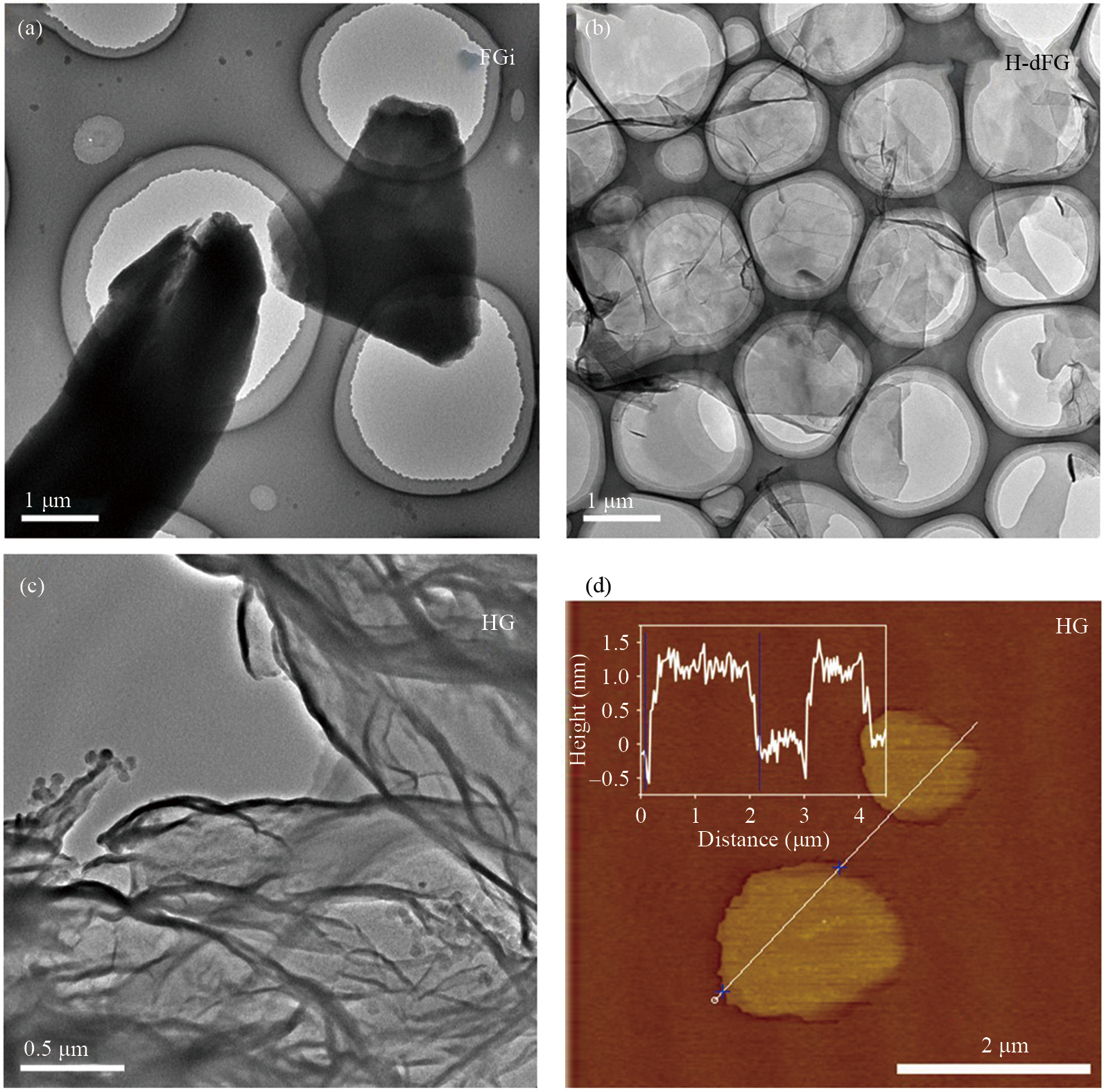
The morphology and microstructure of FGi, H-dFG, and HG were investigated via transmission electron microscopy (TEM) and atomic force microscopy (AFM). As shown in Fig. 1(a), it exhibits bulk features with micron-scale size of FGi. A layered structure could be recognized at the edge of FGi, making it an ideal precursor to be cleaved into a two-dimensional (2D) structure. Figure 1(b) shows the lateral size of H-dFG is a few microns and relatively flat, while HG exhibits typically 2D wrinkled (Fig. 1(c)) after in situ hydrogenation. This indicates that FGi is exfoliated into a two-dimensional layered structure due to thermal expansion after thermal annealing. Shown in Fig. 1(d) is the AFM image of HG, it is found that the thickness of HG is about 1.5 nm implying that it has a few layers as well. These results indicate that H-dFG and HG maintain the few-layer structure of graphene.
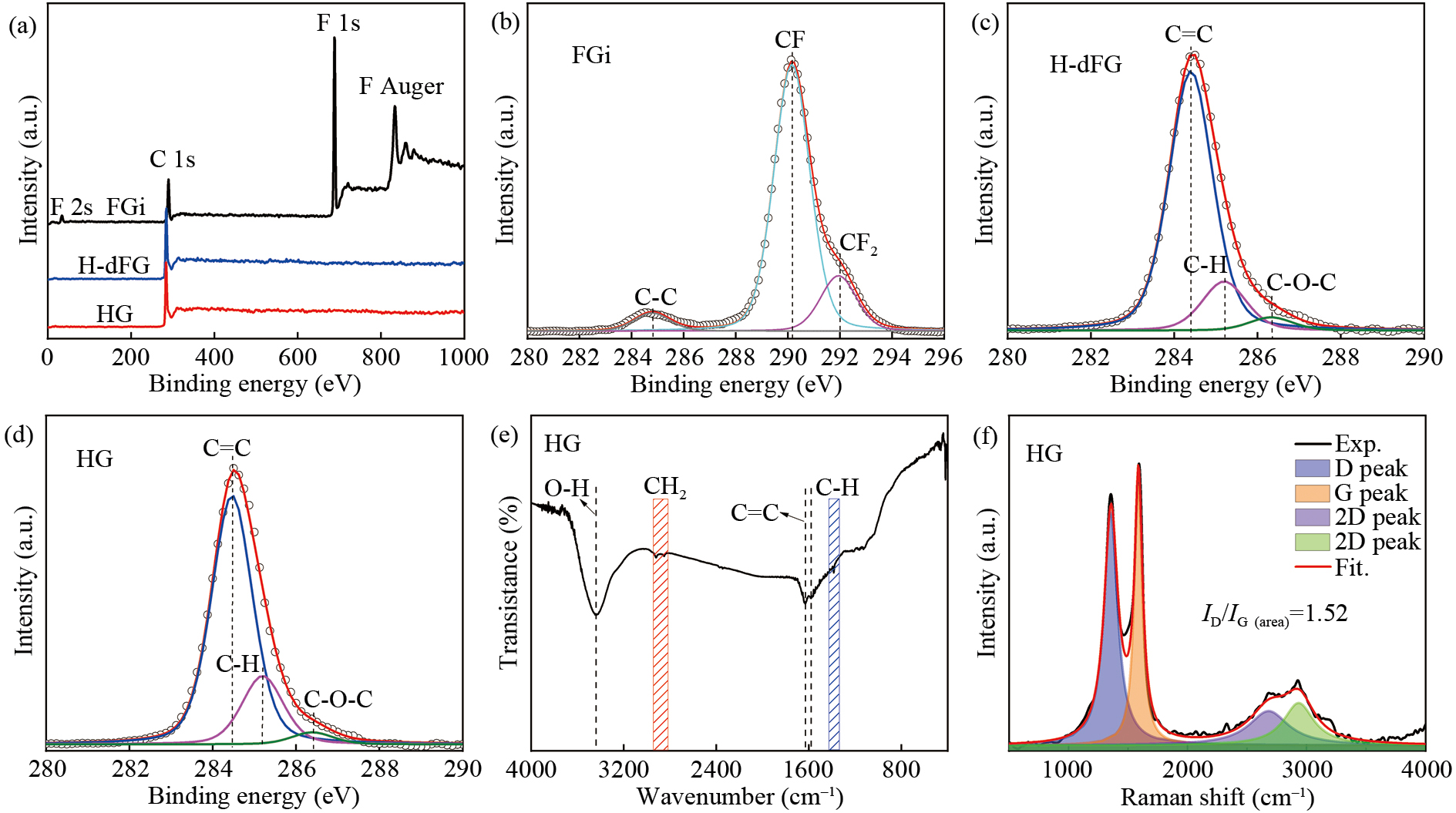
X-ray photoelectron spectroscopy (XPS) survey spectra show there are no O atoms and F atoms in H-dFG and HG samples. To explore the chemical environment variation during the hydrogenation, the fine-scanned C 1s spectra of FGi, H-dFG, and the HG samples were performed in Fig. 2(b)–(d). FGi was deconvoluted into three subpeaks located at ~284.6, 290.1, and 292.0 eV (Fig. 2(b)), which may be respectively attributed to C-C, CF, and CF2 [31]. Figures 2(c) and 2(d) were deconvoluted into three sub-peaks located at ~284.5, 285.2, and 286.3 eV, which ascribe respectively to C=C, C-H, and C-O-C [32]. Indicating that H atoms exist in the form of CH bonds after Hydrogenated. From the area of the peak, it can be concluded that HG has more CH bonds than H-dFG. This is due to the large number of vacancies created in the FGi defluorination process. FGi is exposed to atmosphere rich in H atoms, leading to in-situ hydrogenation in HG. However, the vacancies of dFG are reconstructed first and then hydrogenated, so the content of the H atom is less. The groups in HG can also be further defined by FTIR spectroscopy in Fig. 2(e). The results show that in addition to the C=C sp2 vibration peak (1635.5 cm–1), there are also C-H stretching vibration peaks (1385 cm–1) and CH2 (2850–2920 cm–1) vibration peaks in the sample [33]. Raman spectroscopy is a powerful tool for measuring sp2 domains and the disorder in carbon materials, we performed Raman measurements on HG (Fig. 2(f)). As shown, the D band at ~1350 cm–1 is a disordered band associated with structural defects. The G band at ~1570 cm–1 which arises from sp2 carbon domains. The area ratio of the D band to the G band (ID/IG) is 1.52, which implies that HG has disordered domains.
Due to the limitations of X-ray Photoelectron Spectroscopy, it is not possible to directly detect hydrogen elements in the samples. Therefore, we need to rely on other characterization techniques to analyze the hydrogen content in the samples, one of which is elemental analysis [27]. Table 1 presents the elemental analysis results of the H-dFG and HG samples. It can be seen from the table that both the H-dFG and HG samples have been successfully hydrogenated. The hydrogen content in the H-dFG sample (23.91 at.%) is higher than that in the HG (18.17%) sample after hydrogenation. This is because hydrogen atoms tend to form large clusters on the basal plane of H-dFG, while the presence of vacancies in the HG sample hinders the clustering of hydrogen atoms. Although H-dFG has high hydrogen content, it cannot provide magnetic moments because most of the hydrogen atoms in the clusters are paired. In contrast, HG contains a larger number of unpaired hydrogen atoms.
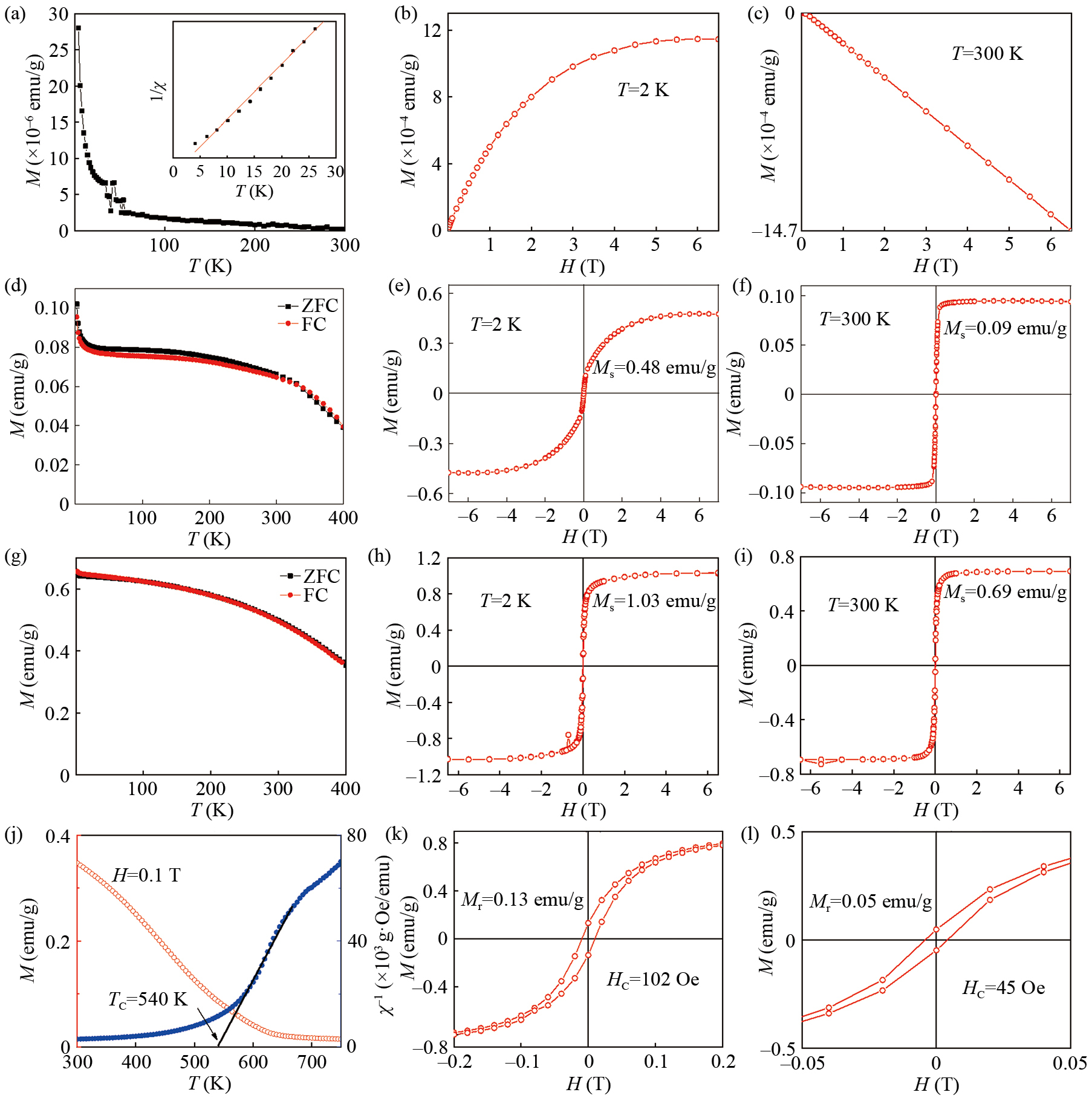
In order to investigate the magnetic moments provided by hydrogen atoms in H-dFG and HG, the magnetization measurements were performed with a superconducting quantum interference device (SQUID). Shown in Fig. 3(a) is the dependence of magnetization (M) on temperature (T) for bulk FGi. The inset is the corresponding 1/χ–T curve which fits well with the Curie law χ = C/T. It should be noted that bulk FGi is purely Curie-like paramagnetic. By subtracting the corresponding 2 K linear diamagnetic characteristic, we thus can obtain the pure positive signal (Fig. 3(b)). The M-H curve is well fitted using the Brillouin function, indicating the paramagnetic in FGi. There is no doubt that it exhibits diamagnetism at 300 K (Fig. 3(c)). As shown in Figs. 3(d)–3(i), the hydrogenated graphene showed room-temperature ferromagnetism. As previously reported, hydrogen atoms absorbed on graphene can remove pz orbitals from the π-graphene system, inducing magnetic moments into the graphene lattice [26]. Figures 3(d) and 3(g) show the zero-field-cooled (ZFC) and field-cooled (FC) M-T curves of H-dFG and HG in 0.1 T, respectively. Specifically, the analogous line types of ZFC and FC M-T curves are the symbols of the FM phase. In the low-temperature region, the magnetism of H-dFG has a significant decline compared to HG. This indicates that there is a paramagnetic phase in the H-dFG sample, while HG is almost pure ferromagnetic accompanied by spontaneous moments. The slow saturation of the H-dFG M-H curve at 2 K (Fig. 3(e)) also proves this, while the HG M-H curve saturation rapidly (Fig. 3(h)). Both H-dFG and HG M-H curves are rapidly saturated at 300 K. These are typical ferromagnetic properties. Figures 3(k) and 3(l) are magnifications of the M-H curves at low magnetic fields of Figs. 3(h) and 3(i), while the distinct hysteresis loops demonstrate the FM behavior. HG has a stronger saturation magnetization (Ms) compared to H-dFG. The 300 K Ms in HG is 0.69 emu/g, which is 7.67 times that in H-dFG. Indicating that HG contains a larger number of unpaired hydrogen atoms. To exclude the influence of magnetic impurities on magnetism [34], we conduct an inductively coupled plasma (ICP) atomic emission spectrometry measurement on both pristine FGi, H-dFG, and HG samples after finishing the detailed magnetic measurements (Table 2). The result clearly shows that all of the samples have ultrahigh purity, indicating that the observed magnetism is the intrinsic signal for all of the samples. To investigate the value of Curie temperature (TC) in HG, the temperature dependence of magnetization at high temperatures was measured in Fig. 3(j). Curie-Weiss law is obeyed above 550 K with more than 99% reliability, and the extrapolation of the linear fitting region yields the intersection with the temperature axis at 540 K for HG. The defect-induced itinerant magnetism is responsible for the experimentally observed high-TC ferromagnetism [35]. The results indicate that vacancies introduce additional magnetic edge atoms, and enhance the coupling between magnetic moments.
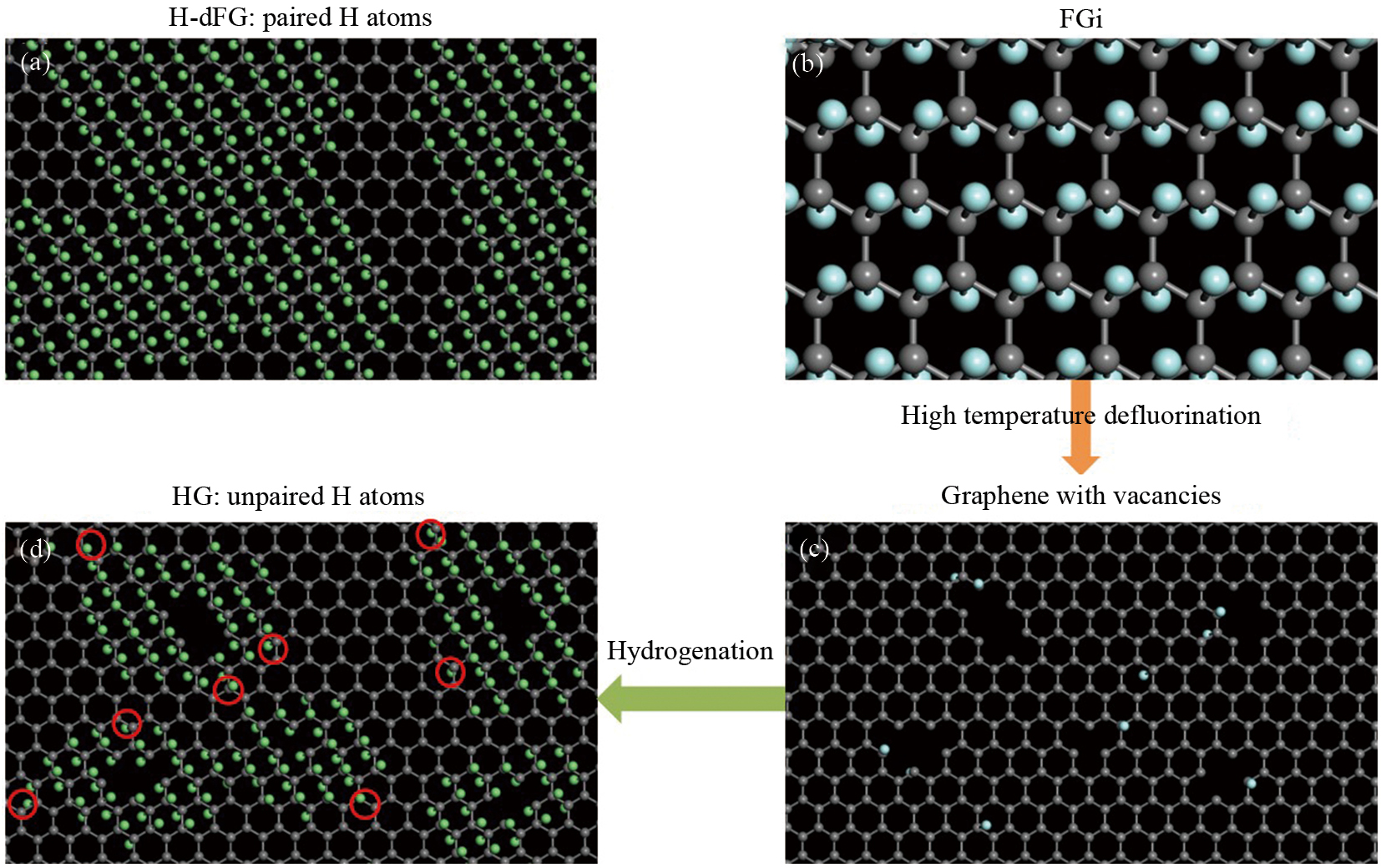
The H-dFG sample was obtained through two steps: (1) FGi was annealed in argon to produce dFG; (2) dFG was subsequently annealed in a hydrogen atmosphere to produce H-dFG. During the first process, the vacancies generated by the defluorination of FGi would recombine in the argon atmosphere. In other words, the precursor used was graphene with recombined vacancies. Due to the low migration barrier of H atoms, H atoms will form large clusters at the base surface of graphene, as shown in Fig. 4(a). These H atoms with counterparts on the neighboring sites do not contribute to the magnetic moment, resulting in a decrease in magnetism. The case of HG is different because the precursor is FGi (Fig. 4(b)). As FGi is unstable at a high temperature, thermal defluorination of FGi can consume C and F atoms and thus introduce vacancies in the graphite lattice (Fig. 4(c)). In the atmosphere of the H atom, hydrogenation preferentially occurs at the vacancy sites [36]. Forming a small cluster in the center of the vacancy, and a large number of unpaired H atoms will appear at the edge of the small cluster (Fig. 4(d)). As we've reported before, the vacancy reduces the large clusters, and stabilizes the small clusters of hydrogen [29, 30]. Increasing the proportion of unpaired H atoms at cluster edges enhances the coupling between magnetic moments.
In summary, we have developed a novel and efficient vacancy-assisted hydrogenation method to enhance the introduction of magnetic moments in graphene. Conventional hydrogenation processes often result in hydrogen clustering, leading to weak ferromagnetism. By leveraging vacancy defects created through thermal annealing of fluorinated graphite in a hydrogen atmosphere, we successfully synthesized hydrogenated graphene (HG) with significantly improved magnetic properties. The presence of vacancies stabilizes small hydrogen clusters and increases the proportion of unpaired hydrogen atoms at cluster edges, thereby strengthening magnetic coupling. Our HG samples exhibit a remarkably high Curie temperature of 540 K and a room-temperature saturation magnetization of 0.69 emu/g, surpassing previously reported values. These results underscore the potential of vacancy-assisted hydrogenation as a viable strategy for engineering magnetic graphene materials, opening new possibilities for graphene-based spintronic applications.
FGi. FGi was bought from Shanghai CarFluor Chemicals Co., Ltd.
Defluorination of FGi (dFG). The dFG sample was prepared by annealing FGi in argon at 600 ℃ for 1 h under ambient pressure. In detail, the tubular furnace is used for annealing. FGi sample was spread on a quartz boat which was placed in a quartz tube reactor. Then argon (99.99%) at a rate of 100 sccm was maintained for 40 min to get rid of air. After heating the furnace from RT to 600 ℃, the quartz boat was introduced into the furnace while argon was kept at a rate of 20 sccm. After 1 h, the tube was rapidly moved out, and the dFG sample was obtained.
Hydrogenation of dFG (H-dFG). The H-dFG sample was prepared by annealing dFG in hydrogen at 600 ℃ for 1 h under ambient pressure. As mentioned above, dFG was spread on a quartz boat which was placed in a quartz reaction tube in a tubular furnace. Using a hydrogen generator to produce hydrogen at a rate of 100 sccm was maintained for 40 min to get rid of air [37]. After heating the furnace from RT to 600 ℃, the quartz boat was introduced into the furnace while hydrogen was kept at a rate of 20 sccm. After 1 h, the tube was rapidly moved out, and the H-dFG sample was obtained.
Hydrogenation of FGi (HG). The HG sample was prepared by annealing FGi in hydrogen directly at 600 ℃ for 1 h under ambient pressure. FGi was spread on a quartz boat which was placed in a quartz reaction tube in a tubular furnace. Using a hydrogen generator to produce hydrogen at a rate of 100 sccm was maintained for 40 min to get rid of air. After heating the furnace from RT to 600 ℃, the quartz boat was introduced into the furnace while hydrogen was kept at a rate of 20 sccm. After 1 h, the tube was rapidly moved out, and the HG sample was obtained.
Microstructure characterization. The morphologies were investigated by transmission electron microscopy (TEM, FEI Tecnai-F20). X-ray photoelectron spectroscopy measurements were carried on a PHI5000 VersaProbe (ULVAC–PHI, Japan) using 200 W mono-chromated Al Ka radiation. Raman spectra were obtained by confocal Raman microscope (LabRAM Aramis, Japan) using a laser excitation of 532 nm.
Magnetic measurements. The magnetic properties of the powdered samples were measured using a superconducting quantum interference device (SQUID) magnetometer with a sensitivity better than 10−8 emu (Quantum Design MPMS-XL, USA), and all data were corrected for the diamagnetic contribution by subtracting the corresponding linear diamagnetic background measured at 300 K. The concentrations of magnetic impurity elements (such as Fe, Co, Ni or Mn) of all the samples are below 20 ppm measured by ICP spectrometry (Jarrell-Ash, USA).
The authors acknowledge support from the National Natural Science Foundation of China (Grant Nos. 12104352 and 12204294), the China National Postdoctoral Programme for Innovative Talents (No. BX20230281), and the Natural Science Basic Research Program of Shaanxi (Program No. 2023JC-XJ-01), Xidian University Specially Funded Project for Interdisciplinary Exploration (No. TZJH2024064), and the China Postdoctoral Science Foundation (Certificate No. 2024M752520).
Y. Wang, W. Xu, D. Yang, Y. Zhang, Y. Xu, Z. Cheng, X. Mi, Y. Wu, Y. Liu, and Y. Hao, "Above-room-temperature strong ferromagnetism in 2D MnB nanosheet," ACS Nano, vol. 17, pp. 24320–24328, 2023.
Y. Wu, J. Wang, G. Yuan, Y. Chen, K. Liang, D. Yang, Y. Liu, W. Luo, S. Xing, and Y. Zou, "Symmetry engineering in a 2D transition metal enables reconfigurable P-and N-Type FETs," Nano Letters, vol. 25, pp. 1994–2001, 2025.
Y. Wu, Y. Liu, Y. Li, Z. Wei, S. Xing, Y. Wang, D. Zhu, Z. Guo, A. Zhang, and G. Yuan, "Symmetry engineering in 2D bioelectronics facilitating augmented biosensing interfaces," Proceedings of the National Academy of Sciences, vol. 121, p. e2412684121, 2024.
Y. Wang, D. Yang, W. Xu, Y. Xu, Y. Zhang, Z. Cheng, Y. Wu, X. Gan, W. Zhong, and Y. Liu, "Room-temperature ferromagnetism and piezoelectricity in metal-free 2D semiconductor crystalline carbon nitride," Nano Research, vol. 17, pp. 5670–5679, 2024.
Y. Wang, D. Yang, S. Wang, W. Xu, Y. Zhang, T. K. Johal, Y. Xu, Y. Wang, Y. Zhang, and Y. Zhang, "p-Type vdW semiconductor CrSCl featuring multipolarity coexistence," ACS Materials Letters, vol. 7, pp. 636–645, 2025.
Y. Wu, Y. Li, Y. Liu, D. Zhu, S. Xing, N. Lambert, H. Weisbecker, S. Liu, B. Davis, and L. Zhang, "Orbit symmetry breaking in MXene implements enhanced soft bioelectronic implants," Science Advances, vol. 10, p. eadp8866, 2024.
Y. Wang, Y. Guo, Z. Wang, L. Fu, Y. Zhang, Y. Xu, S. Yuan, H. Pan, Y. Du, J. Wang, and N. Tang, "Realization of strong room-temperature ferromagnetism in atomically thin 2D carbon nitride sheets by thermal annealing," ACS Nano, vol. 15, pp. 12069–12076, 2021.
K. S. Novoselov, Z. Jiang, Y. Zhang, S. V. Morozov, and A. K. Geim, "Room-temperature quantum hall Effect in graphene," Science, vol. 315, pp. 1379, 2007.
W. Han, R. K. Kawakami, M. Gmitra, and J. Fabian, "Graphene spintronics," Nature Nanotechnology, vol. 9, pp. 794–807, 2014.
B. Dlubak, M. B. Martin, C. Deranlot, B. Servet, S. Xavier, R. Mattana, M. Sprinkle, C. Berger, W. A. De Heer, and F. Petroff, "Highly efficient spin transport in epitaxial graphene on SiC," Nature Physics, vol. 8, pp. 557–561, 2012.
G. Zhang, H. Wu, L. Yang, W. Jin, W. Zhang, and H. Chang, "Graphene-based spintronics," Applied Physics Reviews, vol. 11, p. 021308, 2024.
K. S. Novoselov, A. K. Geim, S. V. Morozov, D.-E. Jiang, Y. Zhang, S. V. Dubonos, I. V. Grigorieva, and A. A. Firsov, "Electric field effect in atomically thin carbon films," Science, vol. 306, pp. 666–669, 2004.
Z. Li, S. Li, Y. Xu, and N. Tang, "Recent advances in magnetism of graphene from 0D to 2D," Chemical Communications, vol. 59, pp. 6286–6300, 2023.
S. C. Ray, "Possible magnetic behaviors of 2D-Graphene (:H/N/Si) materials: A brief review," e-Journal of Surface Science and Nanotechnology, vol. 22, pp. 296–315, 2024.
O. V. Yazyev, "Emergence of magnetism in graphene materials and nanostructures," Reports on Progress in Physics, vol. 73, pp. 56501–56516, 2010.
D. C. Elias, R. R. Nair, T. Mohiuddin, S. Morozov, P. Blake, M. Halsall, A. C. Ferrari, D. Boukhvalov, M. Katsnelson, and A. Geim, "Control of graphene's properties by reversible hydrogenation: Evidence for graphane," Science, vol. 323, pp. 610–613, 2009.
K. E. Whitener, "Hydrogenated graphene: A user's guide," Journal of Vacuum Science & Technology A, vol. 36, p. 05G401, 2018.
Z. Shi, E. M. Nica, and I. Affleck, "Kondo effect due to a hydrogen impurity in graphene: A multichannel Kondo problem with diverging hybridization," Physical Review B, vol. 100, p. 125158, 2019.
L. Hao and C. Ting, "Minimal tight-binding model for the distinct magnetic orders of semihydrogenated and semifluorinated graphene," Physical Review B, vol. 108, p. 245120, 2023.
Y. Song, M. Chen, X. Xie, X. Liu, J. Li, F. M. Peeters, and L. Li, "Hydrogenation-controlled band engineering of dumbbell graphene," Nano Energy, vol. 127, p. 109763, 2024.
J. Zhou, Q. Wang, Q. Sun, X. Chen, Y. Kawazoe, and P. Jena, "Ferromagnetism in semihydrogenated graphene sheet," Nano Letters, vol. 9, pp. 3867–3870, 2009.
A. Lopez-Bezanilla and J. L. Lado, "Defect-induced magnetism and Yu-Shiba-Rusinov states in twisted bilayer graphene," Physical Review Materials, vol. 3, p. 084003, 2019.
O. V. Yazyev and L. Helm, "Defect-induced magnetism in graphene," Physical Review B, vol. 75, p. 125408, 2007.
A. K. Singh and B. I. Yakobson, "Electronics and magnetism of patterned graphene nanoroads," Nano Letters, vol. 9, pp. 1540–1543, 2009.
R. Balog, B. Jørgensen, J. Wells, E. Lægsgaard, P. Hofmann, F. Besenbacher, and L. Hornekær, "Atomic hydrogen adsorbate structures on graphene," Journal of the American Chemical Society, vol. 131, pp. 8744–8745, 2009.
H. González-Herrero, J. M. Gómez-Rodríguez, P. Mallet, M. Moaied, J. J. Palacios, C. Salgado, M. M. Ugeda, J.-Y. Veuillen, F. Yndurain, and I. Brihuega, "Atomic-scale control of graphene magnetism by using hydrogen atoms," Science, vol. 352, pp. 437–441, 2016.
A. Y. S. Eng, H. L. Poh, F. Sanek, M. Marysko, S. Matejkova, Z. Sofer, and M. Pumera, "Searching for magnetism in hydrogenated graphene: Using highly hydrogenated graphene prepared via birch reduction of graphite oxides," ACS Nano, vol. 7, pp. 5930–5939, 2013.
A. Giesbers, K. Uhlířová, M. Konečný, E. Peters, M. Burghard, J. Aarts, and C. Flipse, "Interface-induced room-temperature ferromagnetism in hydrogenated epitaxial graphene," Physical Review Letters, vol. 111, p. 166101, 2013.
Q. Feng, N. Tang, F. Liu, Q. Cao, W. Zheng, W. Ren, X. Wan, and Y. Du, "Obtaining high localized spin magnetic moments by fluorination of reduced graphene oxide," ACS Nano, vol. 7, pp. 6729–6734, 2013.
Y. Xu, S. Li, W. Zhang, Y. Liu, J. Liu, M. Di, Y. Wang, Y. Du, and N. Tang, "Universal fluorination-created edge C-F groups in networks of multidimensional carbon materials," The Journal of Physical Chemistry Letters, vol. 12, pp. 7026–7033, 2021.
P. V. Bakharev, M. Huang, M. Saxena, S. W. Lee, S. H. Joo, S. O. Park, J. Dong, D. C. Camacho-Mojica, S. Jin, and Y. Kwon, "Chemically induced transformation of chemical vapour deposition grown bilayer graphene into fluorinated single-layer diamond," Nature Nanotechnology, vol. 15, pp. 59–66, 2020.
A. Nikitin, L.-Å. Näslund, Z. Zhang, and A. Nilsson, "C-H bond formation at the graphite surface studied with core level spectroscopy," Surface Science, vol. 602, pp. 2575–2580, 2008.
A. Y. S. Eng, Z. Sofer, Š. Huber, D. Bouša, M. Maryško, and M. Pumera, "Hydrogenated graphenes by Birch reduction: Influence of electron and proton sources on hydrogenation efficiency, magnetism, and electrochemistry," Chemistry-A European Journal, vol. 21, pp. 16828–16838, 2015.
Y. Wang, Y. Guo, Z. Wang, L. Fu, Y. Zhang, Y. Xu, S. Yuan, H. Pan, Y. Du, and J. Wang, "Realization of strong room-temperature ferromagnetism in atomically thin 2D carbon nitride sheets by thermal annealing," ACS Nano, vol. 15, pp. 12069–12076, 2021.
O. V. Yazyev and L. Helm, "Defect-induced magnetism in graphene," Physical Review B, vol. 75, p. 125408, 2007.
X.-J. Wu, Z.-J. Fei, W.-G. Liu, J. Tan, G.-H. Wang, D.-Q. Xia, K. Deng, X.-K. Chen, D.-T. Xiao, and S.-W. Wu, "Adsorption and desorption of hydrogen on/from single-vacancy and double-vacancy graphenes," Nuclear Science and Techniques, vol. 30, p. 69, 2019.
 Top