ContentsFigures & Tables
The adoption and implementation of electric vehicles (EVs) represents a critical pivot in the quest for sustainable urban mobility, reflecting broader environmental, technological, and operational changes across the globe. As the world pivots towards decarbonization and net-zero emissions, understanding the multifaceted impact of EVs becomes crucial. While existing studies highlight the environmental benefits of EVs, such as reduced greenhouse gas emissions, there is a significant gap in understanding the variability of these benefits based on electricity generation sources, vehicle efficiency, and lifecycle impacts. Additionally, the integration of EVs into urban infrastructures and the optimization of their operational methodologies, especially using advanced AI techniques, require further exploration to ensure a holistic transition to sustainable urban mobility. This literature review explores three interconnected domains for understanding and enhancing the role of EVs in contemporary society: environmental impact and sustainability, pattern analysis and system science, and methodology and operation of EV systems. Through a systematic examination of recent research, we aim to uncover the nuanced impacts of EVs on air quality and greenhouse gas emissions, analyze patterns in EV integration within urban systems, and evaluate methodologies for optimizing EV operations.
The environmental implications of EVs are profound, particularly in the context of reducing urban air pollution and combatting climate change. Studies consistently highlight the potential for EVs to significantly decrease greenhouse gas emissions and other pollutants. However, the actual environmental benefits of EVs can vary greatly depending on several factors, including the sources of electricity generation, vehicle efficiency, and the lifecycle impacts of vehicle production, particularly the extraction and processing of critical minerals required for EV batteries.
Adopting EVs affects not just the environment but also the broader urban and transportation systems. Pattern analysis within this domain focuses on how EVs integrate into and interact with existing infrastructural systems, including the dynamics of charging demand and its implications for the electrical grid. System science further examines the resilience of these systems to external stresses, such as climatic events, and explores the scalability of technologies and infrastructures needed to support a comprehensive transition to electric mobility.
Operational strategies for EVs encompass a range of methodologies aimed at enhancing efficiency and user adoption rates. This involves optimizing charging infrastructure to mitigate grid impacts, employing advanced computational models to forecast electricity demand accurately, and developing machine learning algorithms to monitor and predict the health of EV batteries. Recent advancements in reinforcement learning (RL) have shown significant advantages in handling continuous decision-making tasks, effectively optimizing smart charging strategies, and addressing dynamic uncertainties, with applications spanning from single-agent reinforcement learning for individual EV control to multi-agent reinforcement learning for coordinated EV charging behaviors. The above methodologies are crucial for ensuring the operational viability of EVs and facilitating their seamless integration into daily life and existing transportation frameworks.
In this paper, we aim to conduct a systematic literature review of recent studies in the fields of environmental science, urban systems engineering, and operational research related to EVs, focusing on publications from top specialized journals and multidisciplinary journals. We assessed the methodologies employed in these studies, scrutinized the results, and evaluated the implications of these findings for future EV integration and optimization. To achieve this goal: (1) A detailed review of the environmental impacts of EVs, focusing on lifecycle assessments to elucidate the environmental impacts associated with different phases of the EV. (2) Analyzing how EVs are integrated into existing urban and energy systems, with a focus on identifying patterns that can inform more efficient infrastructure planning and development. (3) Evaluation of AI-driven methodologies for managing and optimizing the operation of EVs, particularly through advanced computational techniques and reinforcement learning models. Our review focuses on papers from top-tier journals, specifically addressing three key topics and containing the following keywords:
(1) EVs, environment, and sustainability; (2) EVs, mobility, behaviors, power infrastructure, and resilience; and (3) EVs, machine learning, operation, and management. Notably, over the past five years, dozens of papers on these topics have been published in top-tier journals such as Nature research journals (e.g., Nature Energy, Nature Sustainability, Nature Climate Change, Nature Machine Intelligence, and Nature Communications), Science research journals (e.g., Science Advances), and National Academy of Sciences (PNAS). We will summarize the research advancements in electric transportation across these high-impact journals using databases such as Web of Science, Scopus, and Google Scholar, presenting the information in tables that include details such as authors, titles, journals, novelty, methods, findings, and datasets.
The remainder of this paper is structured as follows: Section 2 delves into the environmental impacts of EVs, detailing the emissions, energy consumption, and resource utilization associated with them to provide a comprehensive view of their environmental footprint. Section 3 explores the integration of EVs into urban and energy systems, highlighting the challenges, solutions, innovative practices, and key learnings from various global contexts. Section 4 reviews the AI-driven operational methodologies for EVs, focusing on predictive machine learning for fleet management of EVs and reinforcement learning for optimizing smart charging strategies. Finally, Section 5 concludes by summarizing the key insights from our review and their implications for transitioning to a more sustainable transportation future.
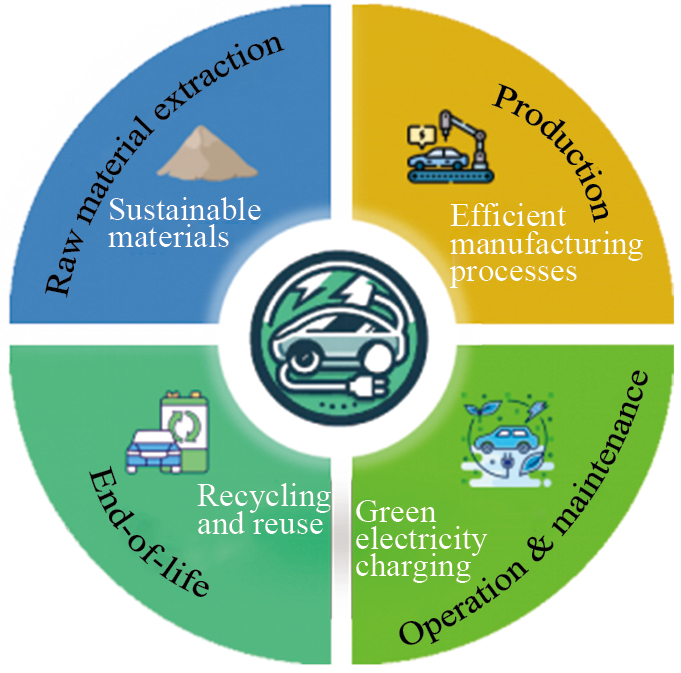
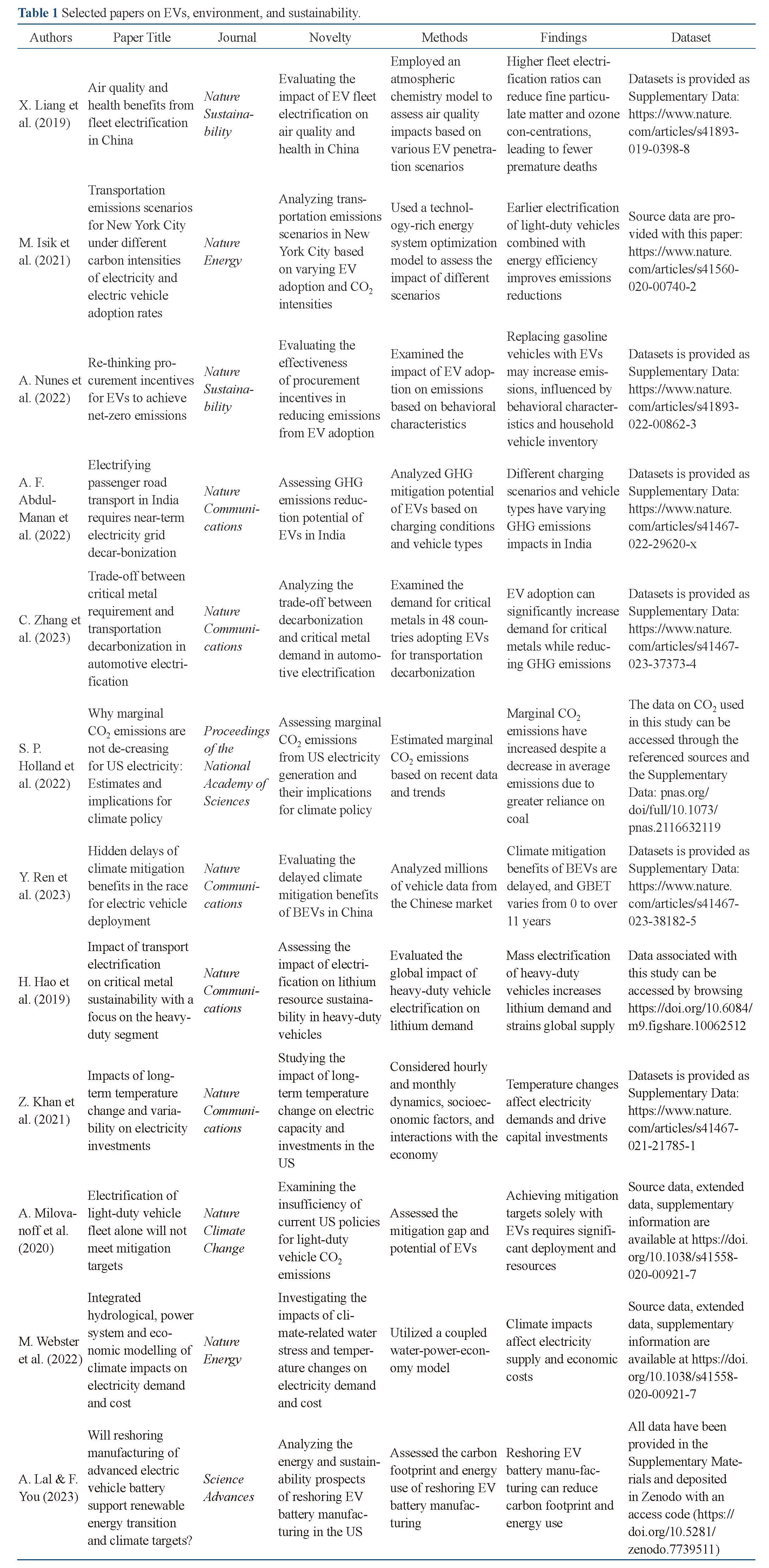
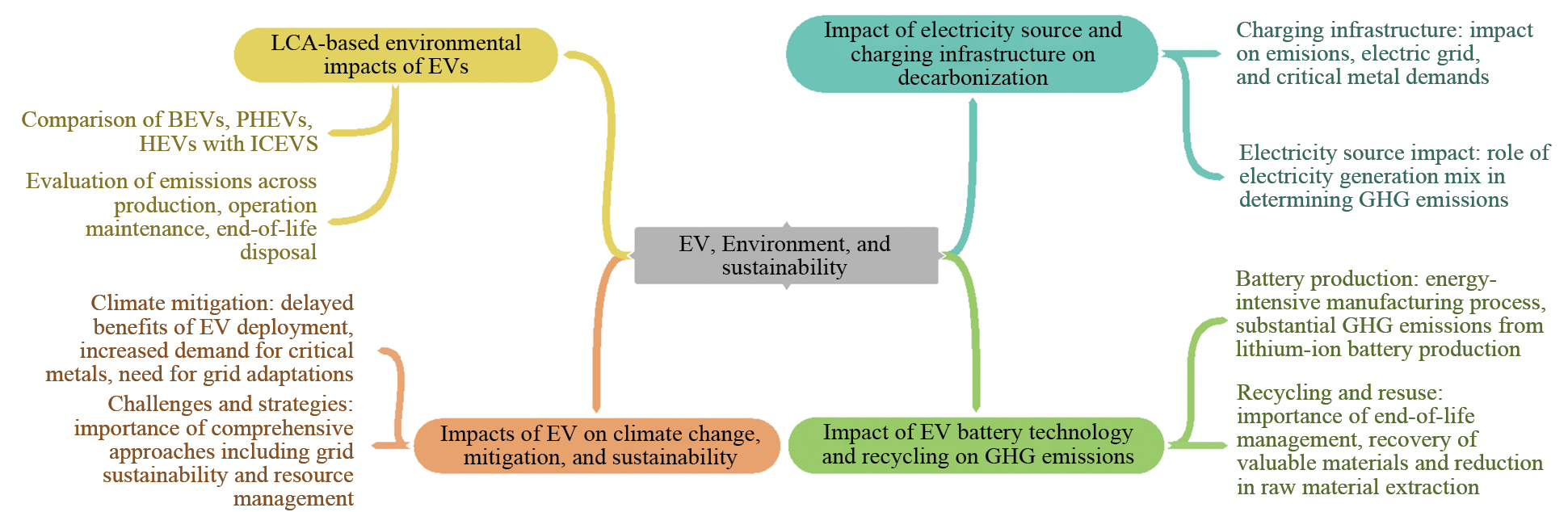
Land transportation is a significant contributor to greenhouse gas (GHG) emissions and air pollution. EVs are increasingly crucial for future urban transport systems, as governments globally catalyze the EV sector to reduce GHG emissions, enhance energy security, improve air quality, and combat global climate change. The life cycle assessment (LCA) method evaluates airborne emissions across the stages of vehicle production, operation and maintenance, and end-of-life disposal. Figure 1 depicts the overview of promising pathways to achieve environmental sustainability of EVs through various LCA stages. Figure 2 presents a summary of the knowledge domains related to the understanding of LCA-based environmental impacts, and impacts of electricity sources, charging infrastructure, EV battery technology, and recycling on Climate Change, Mitigation, and Sustainability. Table 1 shows the details of selected papers from top-tier journals on EVs, environment, and sustainability.
| Authors | Paper Title | Journal | Novelty | Methods | Findings | Dataset |
|---|---|---|---|---|---|---|
| X. Liang et al. (2019) | Air quality and health benefits from fleet electrification in China | Nature Sustainability | Evaluating the impact of EV fleet electrification on air quality and health in China | Employed an atmospheric chemistry model to assess air quality impacts based on various EV penetration scenarios | Higher fleet electrification ratios can reduce fine particulate matter and ozone con-centrations, leading to fewer premature deaths | Datasets is provided as Supplementary Data: https://www.nature.com/articles/s41893-019-0398-8 |
| M. Isik et al. (2021) | Transportation emissions scenarios for New York City under different carbon intensities of electricity and electric vehicle adoption rates | Nature Energy | Analyzing transportation emissions scenarios in New York City based on varying EV adoption and CO2 intensities | Used a technology-rich energy system optimization model to assess the impact of different scenarios | Earlier electrification of light-duty vehicles combined with energy efficiency improves emissions reductions | Source data are provided with this paper: https://www.nature.com/articles/s41560-020-00740-2 |
| A. Nunes et al. (2022) | Re-thinking procurement incentives for EVs to achieve net-zero emissions | Nature Sustainability | Evaluating the effectiveness of procurement incentives in reducing emissions from EV adoption | Examined the impact of EV adoption on emissions based on behavioral characteristics | Replacing gasoline vehicles with EVs may increase emissions, influenced by behavioral characteristics and household vehicle inventory | Datasets is provided as Supplementary Data: https://www.nature.com/articles/s41893-022-00862-3 |
| A. F. Abdul-Manan et al. (2022) | Electrifying passenger road transport in India requires near-term electricity grid decar-bonization | Nature Communications | Assessing GHG emissions reduction potential of EVs in India | Analyzed GHG mitigation potential of EVs based on charging conditions and vehicle types | Different charging scenarios and vehicle types have varying GHG emissions impacts in India | Datasets is provided as Supplementary Data: https://www.nature.com/articles/s41467-022-29620-x |
| C. Zhang et al. (2023) | Trade-off between critical metal requirement and transportation decarbonization in automotive electrification | Nature Communications | Analyzing the trade-off between decarbonization and critical metal demand in automotive electrification | Examined the demand for critical metals in 48 countries adopting EVs for transportation decarbonization | EV adoption can significantly increase demand for critical metals while reducing GHG emissions | Datasets is provided as Supplementary Data: https://www.nature.com/articles/s41467-023-37373-4 |
| S. P. Holland et al. (2022) | Why marginal CO2 emissions are not de-creasing for US electricity: Estimates and implications for climate policy | Proceedings of the National Academy of Sciences | Assessing marginal CO2 emissions from US electricity generation and their implications for climate policy | Estimated marginal CO2 emissions based on recent data and trends | Marginal CO2 emissions have increased despite a decrease in average emissions due to greater reliance on coal | The data on CO2 used in this study can be accessed through the referenced sources and the Supplementary Data: pnas.org/doi/full/10.1073/pnas.2116632119 |
| Y. Ren et al. (2023) | Hidden delays of climate mitigation benefits in the race for electric vehicle deployment | Nature Communications | Evaluating the delayed climate mitigation benefits of BEVs in China | Analyzed millions of vehicle data from the Chinese market | Climate mitigation benefits of BEVs are delayed, and GBET varies from 0 to over 11 years | Datasets is provided as Supplementary Data: https://www.nature.com/articles/s41467-023-38182-5 |
| H. Hao et al. (2019) | Impact of transport electrification on critical metal sustainability with a focus on the heavy-duty segment | Nature Communications | Assessing the impact of electrification on lithium resource sustainability in heavy-duty vehicles | Evaluated the global impact of heavy-duty vehicle electrification on lithium demand | Mass electrification of heavy-duty vehicles increases lithium demand and strains global supply | Data associated with this study can be accessed by browsing https://doi.org/10.6084/m9.figshare.10062512 |
| Z. Khan et al. (2021) | Impacts of long-term temperature change and variability on electricity investments | Nature Communications | Studying the impact of long-term temperature change on electric capacity and investments in the US | Considered hourly and monthly dynamics, socioeconomic factors, and interactions with the economy | Temperature changes affect electricity demands and drive capital investments | Datasets is provided as Supplementary Data: https://www.nature.com/articles/s41467-021-21785-1 |
| A. Milovanoff et al. (2020) | Electrification of light-duty vehicle fleet alone will not meet mitigation targets | Nature Climate Change | Examining the insufficiency of current US policies for light-duty vehicle CO2 emissions | Assessed the mitigation gap and potential of EVs | Achieving mitigation targets solely with EVs requires significant deployment and resources | Source data, extended data, supplementary information are available at https://doi.org/10.1038/s41558-020-00921-7 |
| M. Webster et al. (2022) | Integrated hydrological, power system and economic modelling of climate impacts on electricity demand and cost | Nature Energy | Investigating the impacts of climate-related water stress and temperature changes on electricity demand and cost | Utilized a coupled water-power-economy model | Climate impacts affect electricity supply and economic costs | Source data, extended data, supplementary information are available at https://doi.org/10.1038/s41558-020-00921-7 |
| A. Lal & F. You (2023) | Will reshoring manufacturing of advanced electric vehicle battery support renewable energy transition and climate targets? | Science Advances | Analyzing the energy and sustainability prospects of reshoring EV battery manufacturing in the US | Assessed the carbon footprint and energy use of reshoring EV battery manufacturing | Reshoring EV battery manu-facturing can reduce carbon footprint and energy use | All data have been provided in the Supplementary Materials and deposited in Zenodo with an access code (https://doi.org/10.5281/zenodo.7739511) |
LCA of battery EVs (BEVs), plug-in hybrid EVs (PHEVs), and hybrid EVs (HEVs) have been investigated comprehensively, compared to internal combustion vehicles (ICEV). Hawkins et al. [1] evaluated how well existing studies address the full life cycle environmental impacts of hybrid and EVs, comparing their global warming potential (GWP) with ICEVs. EVs powered by coal had GWP comparable to conventional vehicles, while those using natural gas or low-carbon sources outperformed efficient ICEVs. Coal-dependent regions showed increased SOx emissions for EVs. Onat et al. [2] decided that a vehicle is complex due to various factors. A study compared vehicle options across states, considering electricity sources and driving habits. The study also investigated the impact of solar power on EVs and PHEVs. EVs were found to be the least carbon-intensive in some states, while HEVs were the most energy-efficient in many. However, widespread EV use may not be wise due to the electricity production mix. EVs could be more energy-efficient if electricity production is efficient. Van Mierlo et al. [3] conducted a comparison of environmental aspects among different vehicle technologies, such as compressed natural gas (CNG), BEVs, liquid petroleum gas (LPG), biogas (BG), PHEVs, HEVs, and conventional diesel and petroleum vehicles. The study focused on the environmental assessment of vehicle technologies in the Brussels Capital region using an LCA approach, with a highlight on the potential of BEVs to reduce emissions in the region. The research aimed to determine the environmental impacts of ’clean’ vehicle technologies compared to conventional vehicles, considering the full life cycle, as well as the impacts of electricity production on EVs’ environmental performance. It also investigates the environmental impacts of battery technologies in BEVs, the effect of charging patterns on battery durability, and the influence of driving styles and charging patterns on the environmental performance of BEVs and PHEVs. De Souza et al. [4] involved the evaluation and comparison of the environmental repercussions of automobiles within the Brazilian setting. A life cycle assessment was conducted to evaluate the well-to-wheels analysis for various fuel consumption scenarios and powertrain configurations of a vehicle. Ethanol-fueled scenarios exhibited higher environmental impacts in acidification, eutrophication, and photochemical oxidation categories. Gasoline-fueled scenarios, on the other hand, showed greater impacts on abiotic depletion, fossil fuels abiotic depletion potential, and global warming potential. Vehicles employing lithium-ion batteries demonstrated elevated impacts on human toxicity. Overall, battery EVs displayed the least environmental impacts, followed by ethanol-fueled vehicles. Yang et al. [5] conducted a comparative analysis of emissions from three categories of passenger vehicles in China - ICEVs, PHEVs, and battery electric vehicles (BEVs). They revealed that the emissions of PM2.5 and SO2 from BEVs were 2.6 and 2.1 times higher than those from ICEVs, respectively, whereas the emissions of PM2.5 and SO2 from PHEVs were 1.8 and 1.5 times higher than those from ICEVs, respectively. Under a high renewable energy scenario with increased biomass, the emissions of PM2.5 and SO2 from EVs surpassed those from ICEVs.
EVs are playing a crucial role in the decarbonization of land transportation. Hao et al. [6] addressed the gap by evaluating the global lithium resource impacts of electrifying the heavy-duty vehicle segment. Mass electrification of heavy-duty vehicles, in addition to light-duty vehicles, would significantly increase lithium demand and strain the global lithium supply due to the large battery capacity required for heavy-duty vehicles and the likelihood of battery replacement during their lifespan. Xiong et al. [7] employed a hybrid LCA to evaluate the CO2 emission reduction potential of large-scale vehicle electrification. They utilized a comprehensive database of passenger EVs sold in 2018 and incorporated future scenario analyses that considered various technological advancements. They found that, in 2018, vehicle electrification did not result in emission reductions because the additional emissions from manufacturing new EVs surpassed the avoided emissions from on-road vehicles. However, by 2030, emission reductions could potentially reach 49.64 million tons and up to 62.16 million tons in an optimistic scenario. The correlation analysis using 2018 market-based data and 2030 scenario projections highlighted fuel economy as a key factor in achieving emission mitigation. Nunes et al. [8] found that procurement incentives are a commonly used policy tool to boost electric vehicle (EV) sales, yet their effectiveness in lowering transportation emissions is influenced by the behavioral patterns of EV adopters. Replacing ICEVs with EVs might, in some cases depending on user behavior, increase emissions rather than decrease them. To achieve emissions reductions, procurement incentive programs must be redesigned to redistribute incentives toward the second-hand EV market. This approach would not only promote emissions reductions but also address fiscal prudence and regressivity issues associated with these programs. Automotive electrification can reduce transportation GHG emissions but increases critical metal demand. Zhang et al. [9] found that, in 48 major countries aiming for EV adoption, EV deployment at 40%–100% by 2050 could raise lithium, nickel, cobalt, and manganese demand by 2909%–7513%, 2127%–5426%, 1039%–2684%, and 1099%–2838%, respectively, and platinum group metals by 131%–179% from 2020 levels. Higher EV penetration consistently lowers GHG emissions from fuel use, while emissions from fuel production depend on energy sector decarbonization, potentially reaching "net zero" by 2040. BEV manufacturing is more carbon-intensive, creating an initial greenhouse gas debt that must be offset during their use. Ren et al. [10] found that the GHG break-even time (GBET) for Chinese BEVs ranges from zero to over 11 years, averaging 4.5 years, through analyzing data from millions of vehicles in China. 8% of BEVs produced and sold between 2016 and 2018 will not offset their GHG debt within the eight-year battery warranty period. They recommended increasing the share of BEVs that reach GBET by prioritizing the effective replacement of ICEVs rather than merely accelerating BEV deployment. Milovanoff et al. [11] unveiled climate change strategies that often emphasize technology like EVs. However, current US policies fell short of CO2 emission targets for light-duty vehicles, creating a mitigation gap of up to 19 GtCO2. Filling this gap solely with EVs would require over 350 million EVs, consuming half the national electricity demand and vast critical materials by 2050. Improving the fuel efficiency of conventional vehicles is beneficial, but it will not fully fill the gap.
The transition to EVs represents a significant opportunity to mitigate air pollution and improve public health, particularly when coupled with broader strategies for sustainable energy and transportation systems. Requia et al. [12] conducted a comprehensive review of the environmental impact of EVs, aiming to assist policymakers in promoting sustainable road transportation. They examined the effects of EV adoption on air quality, greenhouse gas emissions, and human health. Findings consistently showed reductions in greenhouse gases and some pollutants, though changes in fine particulate matter (PM) and SO2 varied by context. The benefits of EVs depend on factors like EV type, energy source, driving conditions, charging patterns, infrastructure availability, government policies, and regional climate. Liang et al. [13] utilized an atmospheric chemistry model to assess the impacts of various EV penetration levels on air quality and premature mortality from PM and ozone pollution. Based on their findings, higher fleet electrification ratios can yield substantial air quality, climate, and health benefits. Major benefits were in populous regions, suggesting local governments should enhance EV incentives. This study highlighted that health benefits from fleet electrification in China could surpass climate benefits in the next decade, informing policymakers on developing cost-effective EV strategies. Dynamic wireless power transfer (DWPT) technology has recently garnered significant interest in the electric vehicle (EV) charging market, promising to enhance EV adoption and reduce local air pollution and associated externalities. Lazzeroni et al. [14] conducted an environmental and economic analysis to estimate social cost savings from decarbonizing passenger car mobility, comparing these benefits with the costs of installing and maintaining DWPT infrastructure. The analysis, focused on the six most populous European countries (Italy, France, Germany, Poland, Spain, and the United Kingdom), indicated that estimated social cost savings could support the investment in DWPT infrastructure in nearly all these countries.
The transition to EVs is often heralded as a critical solution to reducing greenhouse gas emissions and advancing global decarbonization efforts. Recent studies provide nuanced insights into the efficacy of this transition, assessing the impact of EV adoption on emissions, the electric grid, and the critical metal demands essential for EV manufacturing. This review synthesizes findings from recent research to offer a comprehensive view of the challenges and opportunities presented by widespread EV adoption.
Although the high initial emissions from battery production, EVs generally exhibit lower GHG emissions during the use phase (i.e., operation and maintenance) compared to ICE vehicles, particularly if the electricity used for charging comes from renewable sources. This reduction in operational emissions helps offset the higher production emissions over the vehicle's lifecycle [15, 16]. The electricity generation mix plays a crucial role in determining the GHG emissions of EVs. Greater reliance on renewable and clean energy sources can maximize the environmental benefits of EVs by significantly reducing their associated emissions. Faria et al. [17] conducted an LCA of conventional and EVs, focusing on primary energy sources and operational GHG emissions. Three electricity mixes (i.e., fossil-based, nuclear-heavy, and renewable-rich) were analyzed. Real-world tests on compact and sub-compact EVs showed that renewable energy does not always guarantee low GHG emissions due to variability. Aggressive driving increased energy usage by 47%, and climate control by 24%–60%. EVs would be more sustainable with better battery technology, eco-driving, and a green electricity mix. Richardson [18] reviewed current literature on EVs, the electric grid, and renewable energy integration, discussing key methods and assumptions, and examining the economic, environmental, and grid impacts of EVs. Research outcomes indicated that EVs can help integrate renewable energy, reducing excess production in electric systems, with detailed research on wind-EV interactions and less on solar PV and EVs. Isik et al. [19] adopted a technology-rich, bottom-up energy system optimization model to evaluate the cost and emissions impacts of New York City's transportation sector CO2 reduction policies through a scenario framework. The findings indicated that early electrification of light-duty vehicles is crucial for substantial emissions reductions. Combined with energy efficiency improvements, these measures supported CO2 reductions even in scenarios with higher CO2-intensive electricity. However, reliance on fossil fuels and structural change requirements challenged cost-effective CO2 reductions in the transportation sector. Uncertainties in electric grid decarbonization had minimal impact on the cost-effectiveness of CO2 reduction pathways in the transportation sector. Marginal CO2 emissions from the electricity sector are crucial for assessing climate policies focused on electricity demand or supply changes. Abdul-Manan et al. [20] analyzed the GHG mitigation potentials of electric 4-wheelers and 2-wheelers in India.
The GHG mitigation potential of electric 4-wheelers in India depends on charging timing and location. Self-charging hybrids can reduce GHGs by 33% but are underutilized. Electric 2-wheelers can achieve a 20% GHG reduction due to their efficiency. A phased approach focusing on 2-wheelers and phasing out coal power is essential for a sustainable mobility transition. Holland et al. [21] estimated marginal CO2 emissions from US electricity generation using the latest comprehensive data, varying by region, hour, and year over the past decade. Despite a significant reduction of 28% in nationally average emissions, marginal emissions increased by 7%, primarily due to increased coal for marginal electricity. Without major changes in the electricity sector, the rise in electricity emissions could negate over half the emission reductions from fewer gasoline vehicles. Therefore, EVs’ potential to reduce emissions largely depends on policies that decarbonize both average and marginal electricity emissions. Mohammed et al. [22] examined the adoption of EVs and the importance of developing efficient, fast-charging infrastructure. It explores planning strategies for deploying fast charging stations, highlighting their dual role as loads and storage, and the integration of renewable energy sources like wind and solar. This review addressed challenges and opportunities in localization, evaluated simulation models and optimization tools, and offered recommendations for researchers and grid authorities to support EV integration with the electrical grid.
The production of EV batteries, particularly lithium-ion batteries, significantly contributes to the life cycle GHG emissions of EVs. The manufacturing process is energy-intensive, involving the extraction and processing of raw materials such as lithium, cobalt, nickel, and manganese. Studies have shown that the production phase of EV batteries results in substantial GHG emissions, often higher than those of internal combustion engine (ICE) vehicles during their production phase [23].
Effective end-of-life management, including the recycling and reuse of EV batteries, can further reduce the environmental impact by recovering valuable materials and decreasing the need for new raw material extraction. Martins et al. [24] reviewed the current and future vehicle landscape, predicting an increase from 1.3 billion to 2 billion vehicles by 2030, especially in BRICS countries. They also examined patents and processes for Li-ion battery recycling, including pyro-, hydro-, and bio-metallurgical methods, highlighting the benefits and future trends towards a circular economy. Xia and Li [25] examined the life cycle environmental impacts of EVs with ICEVs. Repurposing and remanufacturing retired batteries improve their environmental benefits. EVs can reduce GHG emissions and fossil energy consumption but have higher impacts on metal and mineral consumption and human toxicity. Advancing battery technology and improving recycling efficiency are essential for sustainable EV adoption. Global logistics and geopolitical issues highlighted potential raw material shortages for EV batteries. Lal and You [26] analyzed strategies to secure the U.S. EV battery supply chain. Reshoring and ally-shoring can reduce carbon footprints by 15% and energy use by 5%–7%. Cobalt-free batteries could cut emissions by 27%, but switching to blade lithium iron phosphate may reduce these gains. Their findings stressed the importance of using nickel from secondary sources and nickel-rich ores, with supply chain benefits depending on battery technology advancements. To meet net-zero emissions targets, demand for lithium, cobalt, nickel, and graphite in the EV market is expected to rise 26-fold, 6-fold, 12-fold, and 9-fold respectively by 2050 [27]. Addressing this demand requires technological advances, new investments, and careful navigation of competing goals. Sustainable supply uncertainties, environmental, social, and governance challenges, and geopolitical tensions pose significant hurdles. Niri et al. [27] examined the strategies of regulatory bodies, governments, mining companies, and manufacturers across the battery value chain. By integrating these perspectives, it offered comprehensive solutions to optimize transport decarbonization and sustainability.
As the global community intensifies its efforts to combat climate change, EVs are increasingly regarded as a critical component of sustainable transportation strategies. However, recent studies reveal that the path to achieving significant climate mitigation through EVs is fraught with complexities, including delayed benefits, increased demand for critical metals, and the need for comprehensive grid adaptations to accommodate changing energy demands and environmental conditions. This review synthesizes findings from key research articles that explore various aspects of EV deployment and its broader implications on climate goals and grid sustainability.
Milovanoff et al. [11] argue that merely electrifying the light-duty vehicle fleet will not suffice to meet climate mitigation targets. They propose that a broader approach, including enhancements in fuel efficiency and reductions in vehicle ownership and usage, is essential to close the mitigation gap. Khan et al. [28] examine the impacts of long-term temperature changes on electricity demands and investments, illustrating that rising temperatures could significantly increase both electricity demand and the associated capital investments required to maintain grid stability and capacity. Webster et al. [29] use an integrated model to study how climate-related changes, particularly water stress and temperature fluctuations, can affect power systems and economic outcomes. Their findings suggest that such impacts could increase electricity costs and have economic effects far from the initial locations of water stress. Ren et al. [10] and Khan et al. [28] discuss the delayed benefits and the impacts of long-term temperature variability on climate mitigation strategies. Ren et al. [10] highlight the often-overlooked fact that the climate benefits of battery EVs are not immediate but delayed due to the carbon-intensive processes involved in their manufacture. The study emphasizes the importance of not just accelerating EV deployment but ensuring that the vehicles can effectively replace internal combustion engines to realize genuine greenhouse gas (GHG) reductions.
While EVs are a pivotal element of climate mitigation strategies, their deployment must be part of a broader, more nuanced approach that considers delayed environmental benefits, the sustainability of critical resources, and the robust adaptation of power grids. These factors are crucial for ensuring that the transition to EV contributes effectively to global climate targets and sustainable development.
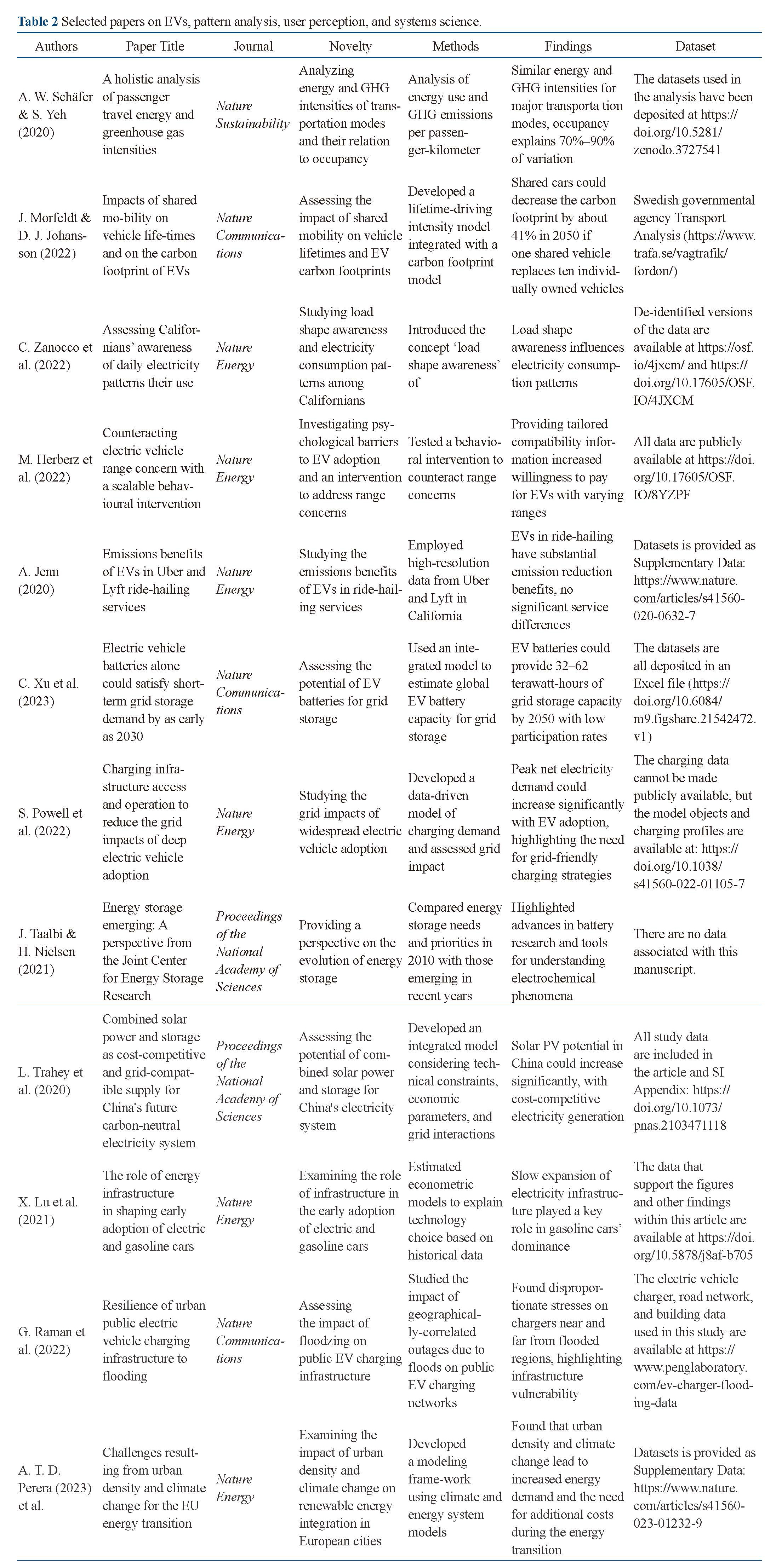
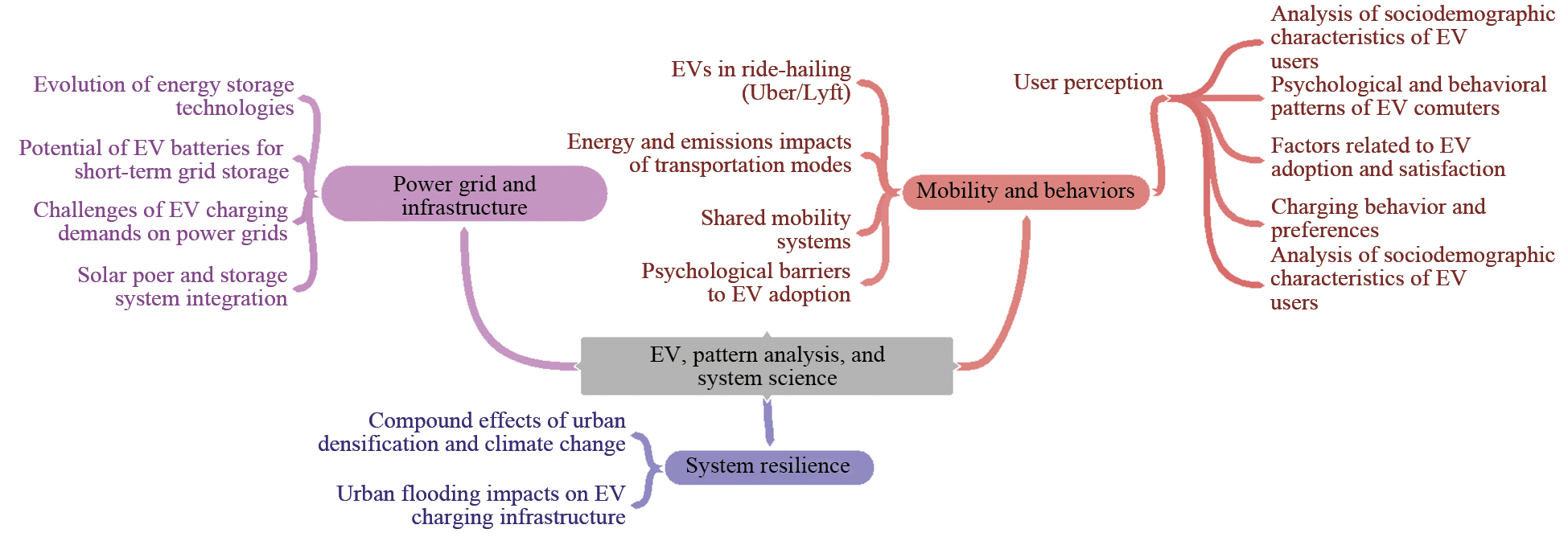
EVs are a crucial strategy for reducing greenhouse gas emissions and achieving sustainability goals. However, their integration into the transportation sector requires not only technological advancements but also significant behavioral and systemic changes. This section conducts a systematic literature review of recent studies in urban systems science related to EVs, exploring various domains including user perceptions, mobility behaviors, infrastructure development, and system resilience. By synthesizing insights from these studies, we aim to provide a comprehensive understanding of the current state and future potential of EV adoption, highlighting the challenges and opportunities in transitioning to a more sustainable transportation system. Figure 3 presents a summary of the knowledge domains related to the understanding of mobility patterns, user perspectives on EVs, EV infrastructure, and the systematic resilience provided by EVs. Table 2 shows the details of selected papers from top-tier journals on EVs, pattern analysis, user perception, and systems science.
| Authors | Paper Title | Journal | Novelty | Methods | Findings | Dataset |
|---|---|---|---|---|---|---|
| A. W. Schäfer & S. Yeh (2020) | A holistic analysis of passenger travel energy and greenhouse gas intensities | Nature Sustainability | Analyzing energy and GHG intensities of transportation modes and their relation to occupancy | Analysis of energy use and GHG emissions per passenger-kilometer | Similar energy and GHG intensities for major transporta tion modes, occupancy explains 70%–90% of variation | The datasets used in the analysis have been deposited at https://doi.org/10.5281/zenodo.3727541 |
| J. Morfeldt & D. J. Johansson (2022) | Impacts of shared mo-bility on vehicle life-times and on the carbon footprint of EVs | Nature Communications | Assessing the impact of shared mobility on vehicle lifetimes and EV carbon footprints | Developed a lifetime-driving intensity model integrated with a carbon footprint model | Shared cars could decrease the carbon footprint by about 41% in 2050 if one shared vehicle replaces ten individually owned vehicles | Swedish governmental agency Transport Analysis (https://www.trafa.se/vagtrafik/fordon/) |
| C. Zanocco et al. (2022) | Assessing Californians’ awareness of daily electricity patterns their use | Nature Energy | Studying load shape awareness and electricity consumption patterns among Californians | Introduced the concept ‘load shape awareness’ of | Load shape awareness influences electricity consumption patterns | De-identified versions of the data are available at https://osf.io/4jxcm/ and https://doi.org/10.17605/OSF.IO/4JXCM |
| M. Herberz et al. (2022) | Counteracting electric vehicle range concern with a scalable behavioural intervention | Nature Energy | Investigating psychological barriers to EV adoption and an intervention to address range concerns | Tested a behavioral intervention to counteract range concerns | Providing tailored compatibility information increased willingness to pay for EVs with varying ranges | All data are publicly available at https://doi.org/10.17605/OSF.IO/8YZPF |
| A. Jenn (2020) | Emissions benefits of EVs in Uber and Lyft ride-hailing services | Nature Energy | Studying the emissions benefits of EVs in ride-hailing services | Employed high-resolution data from Uber and Lyft in California | EVs in ride-hailing have substantial emission reduction benefits, no significant service differences | Datasets is provided as Supplementary Data: https://www.nature.com/articles/s41560-020-0632-7 |
| C. Xu et al. (2023) | Electric vehicle batteries alone could satisfy short-term grid storage demand by as early as 2030 | Nature Communications | Assessing the potential of EV batteries for grid storage | Used an integrated model to estimate global EV battery capacity for grid storage | EV batteries could provide 32–62 terawatt-hours of grid storage capacity by 2050 with low participation rates | The datasets are all deposited in an Excel file (https://doi.org/10.6084/m9.figshare.21542472.v1) |
| S. Powell et al. (2022) | Charging infrastructure access and operation to reduce the grid impacts of deep electric vehicle adoption | Nature Energy | Studying the grid impacts of widespread electric vehicle adoption | Developed a data-driven model of charging demand and assessed grid impact | Peak net electricity demand could increase significantly with EV adoption, highlighting the need for grid-friendly charging strategies | The charging data cannot be made publicly available, but the model objects and charging profiles are available at: https://doi.org/10.1038/s41560-022-01105-7 |
| J. Taalbi & H. Nielsen (2021) | Energy storage emerging: A perspective from the Joint Center for Energy Storage Research | Proceedings of the National Academy of Sciences | Providing a perspective on the evolution of energy storage | Compared energy storage needs and priorities in 2010 with those emerging in recent years | Highlighted advances in battery research and tools for understanding electrochemical phenomena | There are no data associated with this manuscript. |
| L. Trahey et al. (2020) | Combined solar power and storage as cost-competitive and grid-compatible supply for China's future carbon-neutral electricity system | Proceedings of the National Academy of Sciences | Assessing the potential of combined solar power and storage for China's electricity system | Developed an integrated model considering technical constraints, economic parameters, and grid interactions | Solar PV potential in China could increase significantly, with cost-competitive electricity generation | All study data are included in the article and SI Appendix: https://doi.org/10.1073/pnas.2103471118 |
| X. Lu et al. (2021) | The role of energy infrastructure in shaping early adoption of electric and gasoline cars | Nature Energy | Examining the role of infrastructure in the early adoption of electric and gasoline cars | Estimated econometric models to explain technology choice based on historical data | Slow expansion of electricity infrastructure played a key role in gasoline cars’ dominance | The data that support the figures and other findings within this article are available at https://doi.org/10.5878/j8af-b705 |
| G. Raman et al. (2022) | Resilience of urban public electric vehicle charging infrastructure to flooding | Nature Communications | Assessing the impact of floodzing on public EV charging infrastructure | Studied the impact of geographically-correlated outages due to floods on public EV charging networks | Found disproportionate stresses on chargers near and far from flooded regions, highlighting infrastructure vulnerability | The electric vehicle charger, road network, and building data used in this study are available at https://www.penglaboratory.com/ev-charger-flooding-data |
| A. T. D. Perera (2023) et al. | Challenges resulting from urban density and climate change for the EU energy transition | Nature Energy | Examining the impact of urban density and climate change on renewable energy integration in European cities | Developed a modeling frame-work using climate and energy system models | Found that urban density and climate change lead to increased energy demand and the need for additional costs during the energy transition | Datasets is provided as Supplementary Data: https://www.nature.com/articles/s41560-023-01232-9 |
The integration of EVs into the transportation sector is a crucial strategy for reducing greenhouse gas emissions and achieving sustainability goals. However, the transition involves not only technological advancements but also significant behavioral and systemic changes. This review synthesizes recent studies that explore the energy and emission impacts of EVs, shared mobility systems, consumer energy awareness, and behavioral interventions aimed at increasing EV adoption.
There are five domains related to user preferences, perceptions, and behaviors related to EVs: (1) factors related to the adoption and satisfaction of EVs; (2) charging behavior and preferences; (3) psychological and behavioral patterns of EV commuters; (4) analysis of sociodemographic characteristics of EV users; (5) policy implications & incentives for EV adoption.
Pierre et al. [30] identified reasons for choosing EVs among early adopters based on case studies carried out in 2006 and 2008. Key aspects of the adoption lie in the difficulties early EV drivers faced and the usage patterns that governed their use of EVs and mobility. Gambuti et al. [31] presented a strategy for multi-modal trip planning of EVs integrating range and charging. They modeled the network as layers of transportation and charging infrastructure and formalized the problem as a resource-constrained shortest path and solved it through decomposition. The approach satisfies complex user preferences and mitigates range anxiety and can mitigate the impact of EVs charging on a distribution grid when demands are high in peak hours. Stein et al. [32] compared different user interfaces for participating in an EV charging market. They informatively designed a game called Bid2Charge to compare expressive and restricted user preference interfaces, showing that restricting user preferences reduces deliberation times while increasing utility by up to 70%. Anderson et al. [33] also investigated charging behaviors with a survey-based approach. The authors conducted an online survey of 843 German users of EVs on their public charging needs. There are preferences for semi-fast charging, slow charging for frequent use and fast for infrequent, and slow charging where parked for longer periods. A mix of charging options is critical, as stated in the report. Zhang et al. [34] proposed a dynamic time-of-use pricing strategy for charging EVs considering user satisfaction and researched travel patterns to predict the charging capacity of EVs. They studied user charging preferences to set up a satisfaction model and developed a pricing strategy based on microgrid requirements. They successfully developed a dynamic time-of-use charging price that brings economic benefits to both the microgrid and EV users. Zhong et al. [35] developed a fast-charging navigation strategy for EVs considering differences in user time utility, using Dijkstra's algorithm to search for routes, and analyzing the impact of considering user time utility differences on optimizing charging routes. The study reports that users are willing to bear part of the higher travel costs to choose charging paths with shorter charging times. El Hafdaoui and Khallaayoun [36] proposed a comprehensive framework for evaluating alternative fuel vehicles from a social impact standpoint. A case study in Morocco found that hybrid EVs performed the best. Successful adoption depends on government support, cost reductions, and infrastructure development. Battery EVs face challenges with maintenance and charging, while fuel cell EVs have high social infrastructure requirements. Machado et al. [37] evaluated the factors impacting EV adoption by conducting a 2016–2020 systematic review of factors and clustered the results. They highlighted that purchase price and market infancy risks negatively impact adoption, while subjective norms, perceived behavior, prior EV experience, and government incentives positively influence it. Kautish et al. [38] empirically scrutinized the catalysts and inhibitors of EV adoption among young Indian consumers who are deemed as emerging users of EVs. They analyzed data from 391 sustainability-oriented users of EVs using structural equation modeling and found that consumer sustainability consciousness positively influences enablers and inhibitors.
Mobility patterns of EVs also offer a critical view for reducing transportation-related emissions, realizing this potential fully requires addressing both technological and human factors. Improving public awareness of energy use, optimizing vehicle occupancy, and designing effective behavioral interventions are crucial for advancing sustainable mobility. Schäfer and Yeh [39] provide a holistic analysis of the energy and greenhouse gas intensities of various transportation modes, correlating them with occupancy rates. This study analyzes the energy and greenhouse gas intensities of various transportation modes, revealing that occupancy levels play a significant role in determining these intensities. Their findings suggest that improving occupancy rates could lead to substantial energy savings and emission reductions across all transportation modes. Jenn [40] assesses the environmental benefits of using EVs in ride-hailing services like Uber and Lyft. The study highlights that EVs in these services can significantly reduce emissions compared to traditional vehicles, particularly due to their higher utilization rates and efficient use of public charging infrastructure. Morfeldt and Johansson [41] address the impact of shared mobility on vehicle lifetimes and the carbon footprint of EVs, proposing that shared mobility can significantly reduce the carbon footprint if implemented widely. This research explores the implications of shared mobility for vehicle lifetimes and carbon footprints. Their study indicates that shared vehicles, due to higher driving intensities, could significantly reduce carbon footprints compared to individually owned vehicles. However, the study also notes the potential increase in emissions from the additional travel required to pick up passengers in shared mobility setups. Zanocco et al. [42] introduce the concept of ’load shape awareness’ to evaluate Californians’ understanding of their household electricity consumption patterns. They find that increased awareness is linked to more efficient energy use, suggesting that enhancing consumer energy literacy could support more sustainable energy consumption behaviors. Herberz et al. [43] address psychological barriers to EV adoption, particularly range anxiety. Their intervention, which provides tailored information about the compatibility of EV battery ranges with personal travel needs, effectively increases willingness to adopt EVs. This study underscores the importance of addressing psychological factors to boost EV adoption rates.
Integrating EVs into transportation to reduce emissions and achieve sustainability goals requires technological and behavioral changes. Research highlights include adoption factors, charging behavior, psychological patterns, sociodemographic characteristics, and policy incentives. Key studies address EV adoption challenges, multimodal trip planning, dynamic pricing strategies, and social assessments of alternative fuel vehicles. Understanding and addressing both technological and human factors are crucial for advancing sustainable mobility and increasing EV adoption rates.
EVs play a crucial role in the transition towards renewable energy sources, not only as transportation solutions but also as integral components of the energy system. Recent research explores the multifaceted roles of EVs in energy storage, grid dynamics, and infrastructure development. This review synthesizes findings from several key studies that analyze the impact of EV integration into power grids, the potential of EV batteries for grid storage, and the implications for sustainable energy practices.
Trahey et al. [44] provide a perspective from the Joint Center for Energy Storage Research on the evolution of energy storage technologies, particularly lithium-ion batteries. They highlight recent innovations and strategic research aimed at enhancing the performance and sustainability of batteries, which are vital for both personal electronics and grid applications. Lu et al. [45] explore the integration of solar power and storage systems in China, assessing their potential to provide cost-effective and grid-compatible energy solutions. Their study projects significant decreases in power costs and increased solar power potential, emphasizing the synergy between solar energy advancements and storage technologies to meet future energy demands. Taalbi and Nielsen [46] analyze historical transitions in vehicle technologies to draw lessons for current energy infrastructure developments. They argue that early and substantial investments in electric grid infrastructure could have favored the adoption of electric over gasoline cars, suggesting that contemporary infrastructure investments are crucial for supporting sustainable vehicle technologies. The integration of EVs with power grids is scrutinized by Powell et al. [47] and Xu et al. [48], who explore the potential of EV batteries in grid storage and the challenges of deep EV adoption for grid stability. Powell et al. [47] focus on the challenges posed by EV charging demands on the electricity grid, particularly under scenarios of deep EV adoption. Their findings emphasize the importance of strategic charging infrastructure development and operation, which could mitigate potential grid overloads and optimize energy usage during peak demand periods. Xu et al. [48] assess the capability of EV batteries to meet short-term grid storage demands by 2030. Their study uses an integrated model to forecast EV battery availability for grid support, considering factors like battery degradation and market participation. They suggest that EV batteries could significantly contribute to grid stability by providing essential storage capacity, potentially reducing the need for new power infrastructure investments.
In general, these studies illustrate that EVs can significantly contribute to energy storage and grid stability, with proper management of charging infrastructure and advancements in battery technology. Strategic investments in energy infrastructure and innovative technologies are essential to harness the full potential of EVs in achieving sustainable and resilient energy systems.
The integration of EVs into urban settings requires a robust infrastructure that can withstand the impacts of climate change, particularly in dense urban environments where the risk of flooding and other climate-induced challenges are increasing. This section evaluates recent research on the resilience of EV charging networks and urban energy systems to climate-related disruptions, offering insights into the necessary adaptations and strategic planning required to maintain system reliability and efficiency.
Mehrjerdi [49] introduces a vehicle-to-home operation model with a battery swapping mechanism, integrating EVs with solar energy and reserve batteries to ensure continuous operation and improve energy resilience. Raman et al. [50] investigate the effects of urban flooding on public EV charging infrastructure in Greater London. Their study reveals that while flooding does not significantly impact the general operation of EVs for urban driving, it imposes severe stresses on the charging infrastructure, particularly in areas both close to and surprisingly far from flood sites. They document a substantial increase in charger utilization and the distance required to reach available chargers in certain areas, highlighting critical vulnerabilities within the network. The researchers propose several strategies for city planners to enhance the flood resilience of public EV charging systems, emphasizing the need for robust, climate-adaptive planning. Hussain and Musilek [51] discuss the dual role of EVs in providing resilience during power outages and as a resilience resource for buildings and microgrids, highlighting the potential use of second-life EV batteries. Wang et al. [52] provide a resilience assessment framework for electrified road networks, addressing potential failures of fast-charging stations and proposing a linear optimization model to manage traffic and minimize travel time during such failures. Gan et al. [53] propose a method for resilience enhancement in traffic-electric networks, focusing on rerouting power-deficient EVs and redispatching power-sufficient EVs using vehicle-to-grid technology, supported by a pricing mechanism to manage traffic and charging station usage. Perera et al. [54] address the compound effects of urban densification and climate change on the energy transition in European cities. Using multi-scale climate and energy system models, they analyze how changes in wind speed and temperature could affect energy demand and infrastructure resilience. Their findings indicate a significant increase in both peak and annual energy demands, accompanied by higher costs and reduced power supply reliability due to extreme climate events. The study suggests that dense urban areas, particularly in southern Europe, require enhanced design flexibility to improve renewable energy integration and ensure climate resilience.
Studies have examined resilience in EV charging networks and urban energy systems, emphasizing the need for strategic planning and robust infrastructure to maintain reliability and efficiency. These studies highlight the critical importance of designing EV charging infrastructure and urban energy systems that can withstand climate change impacts such as flooding. Collectively, they underscore the necessity of infrastructure development and innovative technologies to leverage EVs for enhanced resilience in energy and transportation systems, addressing the increasing frequency and intensity of climate-related challenges.
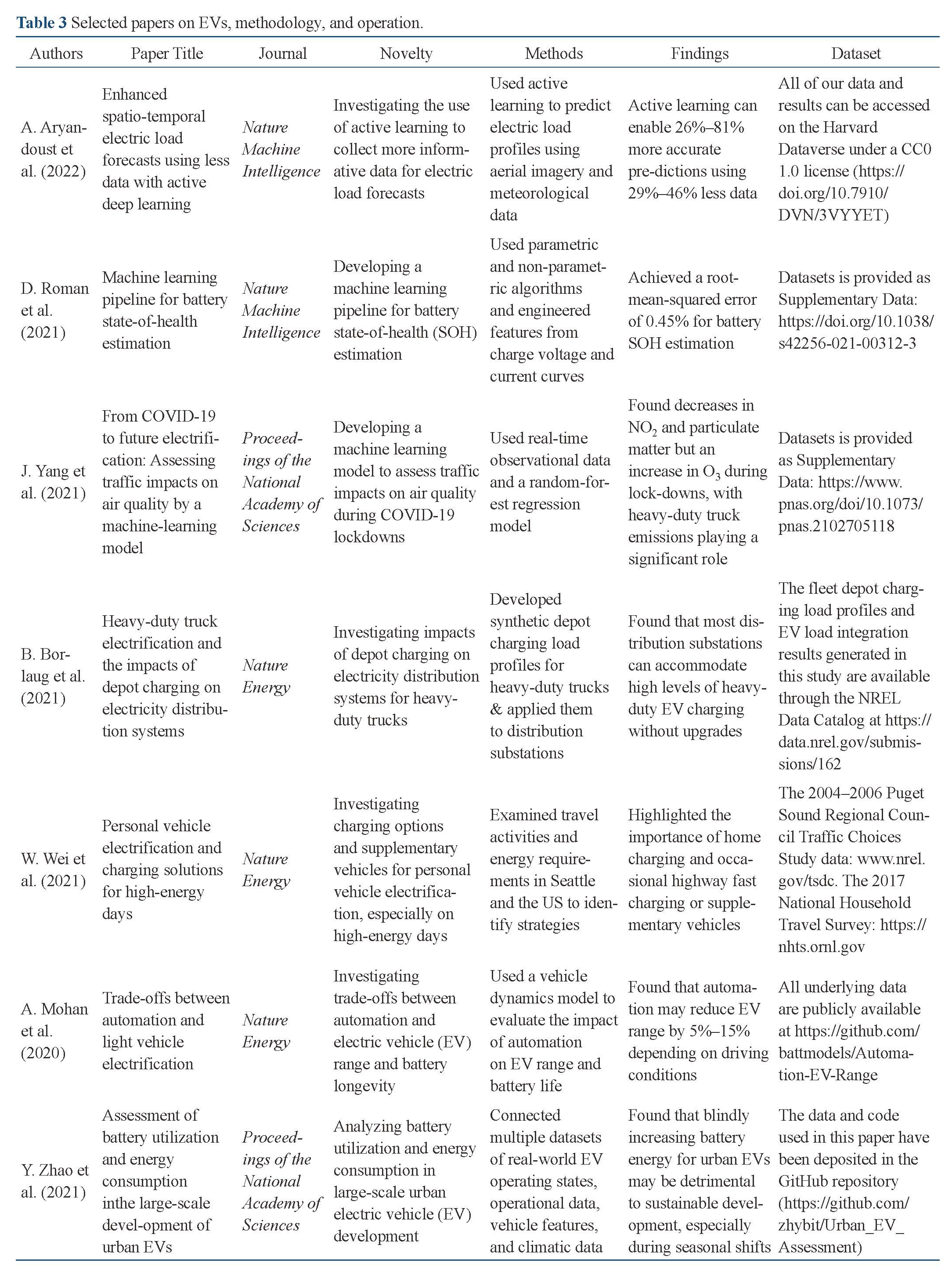
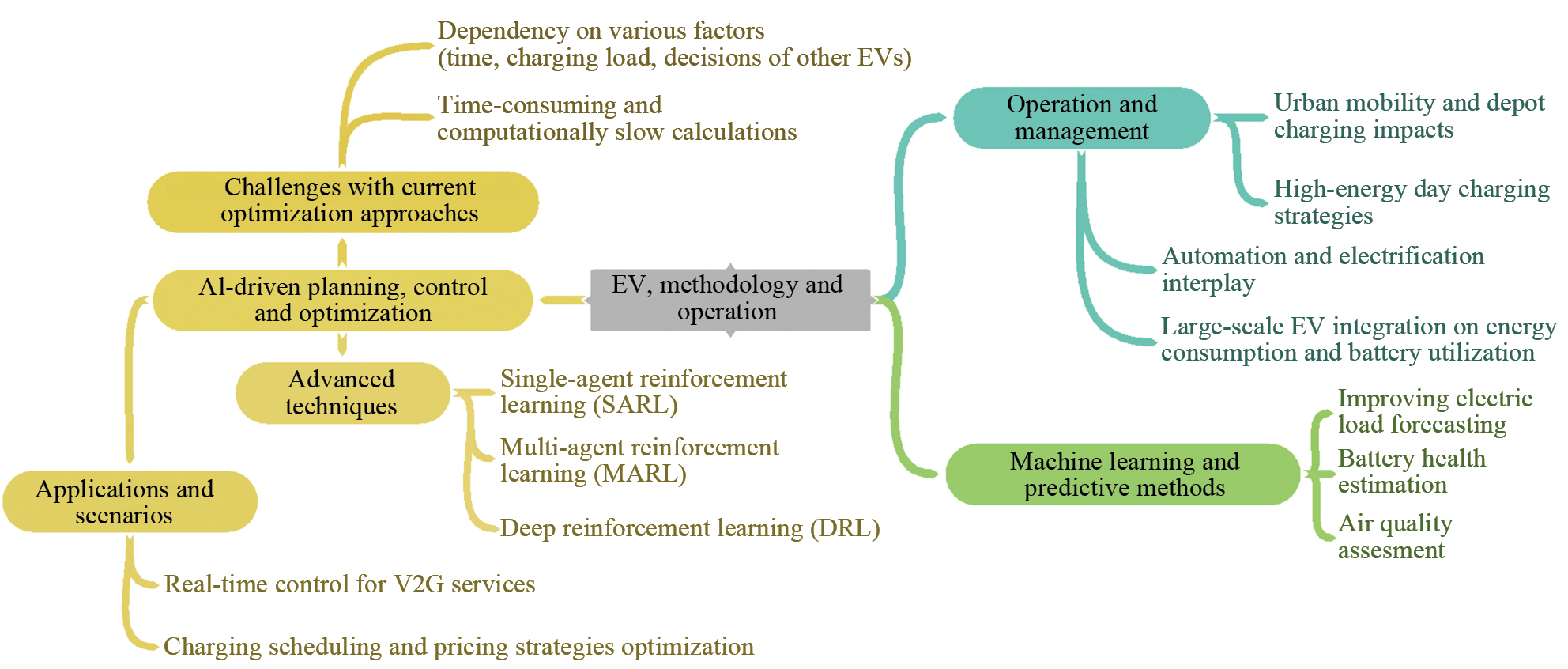
The increasing adoption of electric vehicles (EVs) is transforming urban infrastructure and energy management, prompting a detailed examination of their operational dynamics. This section explores the methodologies and operations that govern the deployment and management of EVs, delineating the intricacies involved in their operation, the application of machine learning for predictive methods, and the advancement of AI-driven planning and control optimizations. It delves into the latest studies that investigate various facets of EV operation, such as depot charging impacts, high-energy day charging strategies, and the nexus between automation and electrification. Furthermore, we highlight the role of machine learning in improving load forecasting, battery health estimation, and air quality assessment, showcasing its potential to optimize EV deployment and mitigate environmental impacts. Finally, we discuss the advancements in AI-driven planning and control strategies, including reinforcement learning (RL) and deep reinforcement learning (DRL), which have demonstrated significant advantages in creating smart charging strategies and managing EV fleets. Figure 4 presents a summary of the knowledge domains related to the understanding of operation and management, machine learning and predictive methods, and AI-driven optimization of EVs. Table 3 shows the details of selected papers from top-tier journals on EVs, methodology, and operation.
| Authors | Paper Title | Journal | Novelty | Methods | Findings | Dataset |
|---|---|---|---|---|---|---|
| A. Aryandoust et al. (2022) | Enhanced spatio-temporal electric load forecasts using less data with active deep learning | Nature Machine Intelligence | Investigating the use of active learning to collect more informative data for electric load forecasts | Used active learning to predict electric load profiles using aerial imagery and meteorological data | Active learning can enable 26%–81% more accurate pre-dictions using 29%–46% less data | All of our data and results can be accessed on the Harvard Dataverse under a CC0 1.0 license (https://doi.org/10.7910/DVN/3VYYET) |
| D. Roman et al. (2021) | Machine learning pipeline for battery state-of-health estimation | Nature Machine Intelligence | Developing a machine learning pipeline for battery state-of-health (SOH) estimation | Used parametric and non-parametric algorithms and engineered features from charge voltage and current curves | Achieved a root-mean-squared error of 0.45% for battery SOH estimation | Datasets is provided as Supplementary Data: https://doi.org/10.1038/s42256-021-00312-3 |
| J. Yang et al. (2021) | From COVID-19 to future electrification: Assessing traffic impacts on air quality by a machine-learning model | Proceedings of the National Academy of Sciences | Developing a machine learning model to assess traffic impacts on air quality during COVID-19 lockdowns | Used real-time observational data and a random-forest regression model | Found decreases in NO2 and particulate matter but an increase in O3 during lock-downs, with heavy-duty truck emissions playing a significant role | Datasets is provided as Supplementary Data: https://www.pnas.org/doi/10.1073/pnas.2102705118 |
| B. Borlaug et al. (2021) | Heavy-duty truck electrification and the impacts of depot charging on electricity distribution systems | Nature Energy | Investigating impacts of depot charging on electricity distribution systems for heavy-duty trucks | Developed synthetic depot charging load profiles for heavy-duty trucks & applied them to distribution substations | Found that most distribution substations can accommodate high levels of heavy-duty EV charging without upgrades | The fleet depot charging load profiles and EV load integration results generated in this study are available through the NREL Data Catalog at https://data.nrel.gov/submissions/162 |
| W. Wei et al. (2021) | Personal vehicle electrification and charging solutions for high-energy days | Nature Energy | Investigating charging options and supplementary vehicles for personal vehicle electrification, especially on high-energy days | Examined travel activities and energy requirements in Seattle and the US to identify strategies | Highlighted the importance of home charging and occasional highway fast charging or supplementary vehicles | The 2004–2006 Puget Sound Regional Council Traffic Choices Study data: www.nrel.gov/tsdc. The 2017 National Household Travel Survey: https://nhts.ornl.gov |
| A. Mohan et al. (2020) | Trade-offs between automation and light vehicle electrification | Nature Energy | Investigating trade-offs between automation and electric vehicle (EV) range and battery longevity | Used a vehicle dynamics model to evaluate the impact of automation on EV range and battery life | Found that automation may reduce EV range by 5%–15% depending on driving conditions | All underlying data are publicly available at https://github.com/battmodels/Automation-EV-Range |
| Y. Zhao et al. (2021) | Assessment of battery utilization and energy consumption inthe large-scale devel-opment of urban EVs | Proceedings of the National Academy of Sciences | Analyzing battery utilization and energy consumption in large-scale urban electric vehicle (EV) development | Connected multiple datasets of real-world EV operating states, operational data, vehicle features, and climatic data | Found that blindly increasing battery energy for urban EVs may be detrimental to sustainable development, especially during seasonal shifts | The data and code used in this paper have been deposited in the GitHub repository (https://github.com/zhybit/Urban_EV_Assessment |
EVs have presented new dynamics in urban mobility, influencing a range of operational strategies. This part examines recent scholarly contributions that explore various aspects of EV operation, including depot charging impacts, high-energy day charging strategies, the interplay between automation and electrification, and the broader implications of large-scale EV integration on urban energy consumption and battery utilization. Borlaug et al. [55] and Wei et al. [56] investigate operational strategies for integrating heavy-duty EVs and personal vehicle electrification within existing infrastructure. Borlaug et al. [55] estimate the effects of electrifying heavy-duty trucks and the consequent demands on electricity distribution systems from depot charging. Their findings indicate that most current distribution systems can handle the increased load from heavy-duty EVs without significant upgrades, provided that depot charging is managed effectively. Wei et al. [56] focus on personal vehicle electrification, particularly managing the infrequent but challenging high-energy demand days. Their study suggests that a combination of home charging and supplementary strategies, such as highway fast charging or access to long-range vehicles, could significantly enhance the feasibility of EVs to meet all user needs, even on the most demanding days. Mohan et al. [57] delve into the trade-offs between incorporating automation in EVs and the implications for vehicle range and battery longevity. They discovered that automation could decrease EV range by 5%–15%, depending on driving conditions, due to increased energy demands from computing and sensor loads. Zhao et al. [58] analyze battery utilization and energy consumption in the context of large-scale urban EV deployment. Their research highlights potential sustainability issues with increasing battery capacity indiscriminately, especially given the variability in energy consumption due to seasonal changes and urban driving patterns.
These studies suggest that while current infrastructure can support an initial surge in EV adoption, particularly for heavy-duty applications, ongoing management and strategic planning are crucial. Innovations in charging strategies and careful consideration of the impacts of vehicle automation and large-scale deployment are essential to optimize the benefits of EVs and ensure sustainable urban mobility.
The integration of EVs into our energy systems and their interaction with environmental factors is increasingly being enhanced by advancements in AI. This review examines recent studies that apply machine learning techniques to improve electric load forecasting, battery health estimation, and air quality assessment, emphasizing the potential of AI to optimize EV deployment and mitigate environmental impacts.
Roman et al. [59] developed a machine learning pipeline to accurately estimate the state of health (SOH) of lithium-ion batteries, which are crucial for the reliability of EVs. The pipeline utilizes both parametric and non-parametric algorithms to analyze battery usage data and predict capacity fade, a key indicator of battery health. This methodology not only ensures the safety and efficiency of EV batteries but also extends their operational life by enabling better maintenance and management practices based on reliable SOH assessments. Yang et al. [60] use a random-forest regression model to analyze the impact of traffic changes on air quality, leveraging data from the COVID-19 pandemic. Their model assesses how reductions in vehicular traffic during lockdowns affected air pollutant levels in Los Angeles, revealing a decrease in NO2 and particulate matter but an increase in O3 levels. This study provides insights into the potential benefits of vehicular electrification on improving urban air quality by simulating similar traffic emission controls. Aryandoust et al. [61] explore the use of active deep learning to improve the accuracy of electric load forecasts in the context of grid decarbonization. Their study demonstrates that active learning techniques can significantly enhance prediction accuracy while reducing data requirements by selectively focusing on more informative data points. This approach not only lowers the costs associated with data collection, such as the deployment of smart meters, but also optimizes the integration of renewable energy sources by providing more precise load predictions.
By improving load forecasting, battery health monitoring, and air quality assessments, predictive methods driven by machine learning not only support the technical management of EVs but also aid in understanding and mitigating their environmental impacts. These advancements underscore the critical role of machine learning in advancing sustainable transportation solutions.
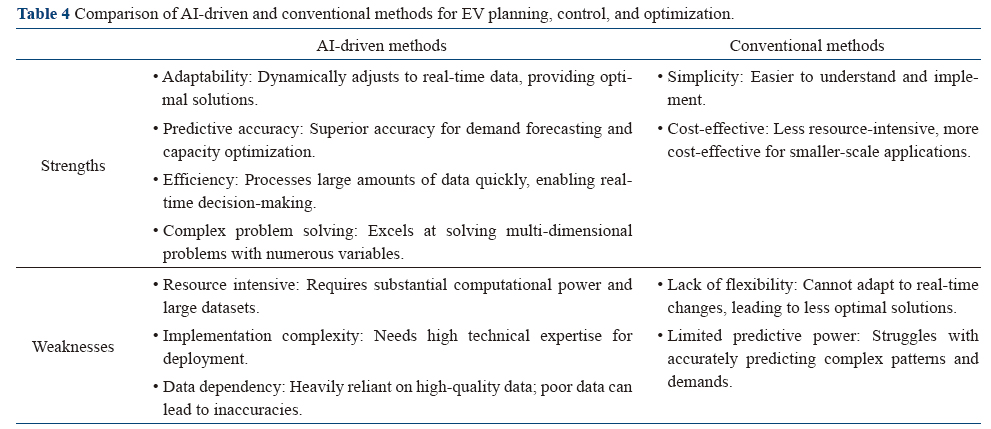
Optimization-based approaches for solving the management and operation problem of EVs face several limitations [62, 63]: First, the control of power depends on many factors such as time, current charging load, and charging decisions of other EVs, and calculating the optimal solution relies on good prediction and boundary condition settings, which is time-consuming and computationally slow. Second, because the algorithms require a lot of scenario abstraction and model customization, optimization-based algorithms are less migratory in terms of scenarios. AI-driven models significantly enhance adaptability, predictive accuracy, and real-time data processing capabilities compared to conventional methods in planning, control, and optimization of EVs. In terms of applications, AI techniques offer advantages in infrastructure planning, charge control, pricing strategies, and routing for EVs [64, 65]. Table 4 highlights the key differences between AI-based and conventional methods across various aspects, emphasizing their respective strengths and weaknesses.
In infrastructure planning, machine learning (ML) algorithms optimize charging station placement and sizing by predicting demand and determining optimal locations using clustering algorithms like K-means and hierarchical clustering [66, 67]. These models cater to both EV user-specific objectives, such as minimizing travel distance and queuing times [68], and grid operator-specific goals, such as maximizing profit and minimizing power loss [69, 70]. Forecasting charging demand and station utilization is another critical application of ML in infrastructure planning. Long-term and short-term forecasts are crucial for efficient daily planning, with algorithms such as Long Short-Term Memory (LSTM), random forest, and k-nearest neighbors (kNN) employed to predict usage patterns based on variables like time, temperature, and precipitation [71, 72]. This capability outperforms traditional methods by adapting to real-time data and providing more accurate predictions.
In charge control and coordination, reinforcement learning (RL) plays a vital role in managing the EV charging process [73]. Uncoordinated charging can strain the grid and increase costs, but EV Smart Charging (EVSC) systems use RL to optimize charging schedules and balance loads [74]. Stakeholders, including grid operators and aggregators, benefit from ML algorithms that manage charging demands and optimize charge/discharge schedules, ensuring peak load reduction and cost savings [75]. RL Techniques like deep Q-networks (DQN), and deep deterministic policy gradient (DDPG) address uncertainties and improve efficiency compared to traditional linear and non-linear programming methods [73, 76].
Dynamic pricing for electric vehicle (EV) charging benefits both service providers and customers by balancing grid loads and increasing profits while reducing waiting times and charging costs [77]. RL models, including Q-Learning and DDPG, optimize pricing and scheduling for both parked and fast-charging EVs, improving efficiency and user satisfaction [78, 79]. This dynamic approach contrasts with conventional static pricing models, offering more flexibility and responsiveness.
In routing and navigation, ML significantly improves efficiency and adaptability [80]. EV routing problems (EVRP) and navigation challenges are addressed using RL models, which anticipate future demands and changing conditions [81]. In navigation, RL helps route EVs from origin to destination while selecting optimal charging stations, managing uncertainties like charging prices and waiting times [82]. Additionally, RL aids in path planning through predictive models for energy consumption, charging costs, speed, and travel time, surpassing conventional linear programming and heuristic approaches in efficiency and adaptability [83].
In general, Reinforcement Learning (RL) algorithms, an emerging computational approach for handling continuous decision-making tasks, have demonstrated significant advantages in developing smart charging and operation strategies for electric vehicles [73, 84]. These RL algorithms excel in creating adaptive and efficient solutions by learning from dynamic environments and optimizing long-term rewards, leading to improved performance and adaptability in real-world applications [85]. In RL, an intelligent agent interacts with an uncertain environment and observes the digital feedback and rewards of the resulting state transitions to gradually learn the optimal behavioral patterns (i.e., policies) for a given situation [62, 86]. RL as an online learning method can effectively utilize the growing data to capture the uncertainty of the system and adapt to various state dynamics [87]. After being well-trained, its policies can provide optimized results fed back to the real environment in a millisecond time window. As a result, RL has demonstrated strong capabilities in real-time automatic control applications, and previous research has successfully applied RL methods to a variety of electric vehicle control problems [84, 87, 88], and the main directions can be categorized into the following two groups.
The first category focuses on single-intelligent problems with the Single-agent Reinforcement Learning (SARL) approach. Qian et al. [89] explore the coordination of smart grid (SG) and intelligent transportation system (ITS) to enhance EV charging navigation. By employing SARL, they tackle the inherent uncertainties in traffic conditions, charging prices, and waiting times at charging stations. Their approach demonstrates adaptability to varying EV driver preferences, highlighting significant reductions in both travel time and charging costs. Jin and Xu [90] introduce a soft actor-critic (SAC) based method to optimize EV charging scheduling in power distribution networks. By establishing the nodal multi-target (NMT) characterization, their approach mitigates the curse of dimensionality and significantly outperforms existing deep reinforcement learning methods, enhancing efficiency under random renewable generation and electricity prices. Shuai et al. [91] delve into a model-free supervisory control methodology for hybrid vehicles in charge-sustaining scenarios using a double Q-learning approach. Their research introduces heuristic action execution policies to improve energy efficiency and maintain battery state-of-charge. The study validates the robustness and effectiveness of double Q-learning in real-world driving conditions, achieving notable energy savings over standard Q-learning methods. Zhang et al. [92] address the EV charging scheduling problem, deemed NP-hard, by formulating it as a Markov Decision Process tackled with deep reinforcement learning. They aim to minimize total charging time and reduce the origin-destination distance for EVs at public charging stations. Their algorithms demonstrate significant improvements in charging efficiency, outperforming established baseline methods and illustrating the practical benefits of integrating SARL in managing the complexities of EV charging.
The second category focuses on multi-intelligent problems with multi-agent reinforcement learning (MARL) methods. However, the application of MARL in the context of EV-assisted service provision is still relatively limited. Shi et al. [86] developed a framework for decentralized training and centralized execution for the problem of cab service for a fleet of EVs. During the training process, the experience of individual EVs is used to train a common strategy. Qian et al. [77] propose a multi-agent deep reinforcement learning method to optimize the pricing strategies of electric vehicle charging stations within urban transportation networks, effectively modeling the competitive pricing game and approximating the Nash Equilibrium to maximize individual payoffs amid complex market environments. Therefore, the problem of dynamics and uncertainty in the training strategy of other intelligences can be appropriately addressed compared to the non-stationary problem in the traditional MARL algorithm. Yan et al. [88] propose a cooperative charging control strategy for EVs using multiagent deep reinforcement learning, effectively coordinating EV charging to prevent transformer overload in the distribution grid while considering dynamic electricity prices and residential load consumption. Zhang et al. [87] introduce a multistep multiagent reinforcement learning approach for optimal energy scheduling in charging stations, effectively balancing energy supply and demand while coordinating purchasing and distribution strategies to enhance economic profits and user satisfaction in the smart grid. Mao et al. [93] present a novel framework for routing and charging scheduling in EV battery swapping systems using a heterogeneous multiagent hypergraph attention actor-critic (HMA-HGAAC) approach. This method effectively addresses the complexities of decentralized partially observable Markov decision processes (Dec-POMDPs), achieving significant cost reductions compared to existing benchmarks in a real-world 180-node transportation network.
In addition, the RL model of QL (Q-learning) and its variants are susceptible to the curse of dimensionality since it relies on lookup tables to represent the Q-value function for each possible state-action pair. In addition, discretization of the state and action space may interfere with the feedback received by the intelligence on the impact of its behavior on the environment and adversely affect the feasible action space, leading to suboptimal control strategies [94]. Deep reinforcement learning (DRL) methods, which are a combination of deep learning techniques and RL algorithms, have been widely used in recent years to solve problems of complex optimal control [84]. Wan et al. [95] proposed a model-free real-time control method based on Deep Q-network (DQN) for optimal power scheduling policy to provide V2G services for smart trolley buses. Liang et al. [96] combined binary linear programming and neural networks in a DRL method, generating an approximate optimal scheduling policy for charging planning, order assignment, and vehicle rebalancing services for an EV fleet. Ding et al. [97] proposed an optimal power scheduling policy based on a role-feedback structure (actor-critic) Deep Deterministic Policy Gradient (DDPG) algorithm for dealing with continuous state and action space tram charging strategies. Jin et al. [73] integrate the Less Demand First (LDF) priority rule with proximal policy optimization (PPO) for efficient EV charging scheduling in battery swapping stations. This approach significantly reduces dimensionality and outperforms classical DRL methods, enhancing cost and waiting time management.
The transition from traditional optimization to advanced RL and DRL approaches offers promising directions for the effective management of EV fleets. These methodologies not only cope better with the dynamic and uncertain nature of smart transportation systems but also provide scalable solutions to enhance operational efficiencies and sustainability in urban mobility.
The increasing adoption of electric vehicles (EVs) is pivotal in the global movement towards sustainable urban mobility, reflecting broader environmental, technological, and operational shifts. This study addresses significant research gaps by exploring the environmental impacts, urban system integration, and operational methodologies of EVs. Our research focused on understanding the lifecycle environmental impacts of EVs, the patterns of EV integration in urban systems, and the optimization of EV operations through advanced methodologies. The primary goals were to elucidate the nuanced environmental benefits of EVs, analyze their integration into urban infrastructure, and evaluate AI-driven approaches for managing EV operations.
In this review, we examined top-tier publications from journals such as Nature, Science, and PNAS, covering the fields of environmental science, urban systems engineering, and operational research related to EVs. We conducted a detailed assessment of the methodologies used in these studies, scrutinized their results, and evaluated the implications for future EV integration and optimization. Our findings highlighted that while EVs have the potential to significantly reduce greenhouse gas emissions and improve urban air quality, their actual environmental benefits depend heavily on factors such as electricity generation sources and the lifecycle impacts of battery production. Furthermore, we identified patterns in EV integration that can inform infrastructure planning and revealed the efficacy of advanced computational techniques, particularly reinforcement learning, in optimizing EV operations.
The major contributions of our study include providing a comprehensive overview of the environmental impacts of EVs, offering insights into the challenges and opportunities of integrating EVs into urban systems and showcasing the potential of AI-driven methodologies to enhance EV operations. These findings have significant implications for policymakers, urban planners, and researchers, suggesting that while EVs are a promising solution for sustainable mobility, their benefits can be maximized through strategic infrastructure development and advanced operational strategies. However, our research is limited by the variability in regional electricity generation sources and the nascent state of some AI methodologies.
As the adoption of electric vehicles (EVs) continues to rise globally, several critical areas warrant further investigation to ensure the efficient and sustainable integration of EVs into existing infrastructures. (1) Future research should prioritize the exploration of vehicle-to-everything (V2X) technologies and their impacts on urban power grids. This involves examining how EVs can support energy storage, grid stability, and infrastructure development, thereby enhancing overall grid resilience and performance. (2) The resilience of EV systems under catastrophic events, such as extreme weather, earthquakes, and power outages, requires thorough examination. This will ensure a reliable energy supply for charging during crises, contributing to the robustness of EV infrastructures. (3) Further studies should delve into the operational differences and synergies between EVs and other components of ACES (Automated, Connected, Electric, and Shared Transportation), with a focus on integrating advanced AI techniques to enhance the efficiency and functionality of these interconnected systems. Moreover, while many studies have provided valuable insights into user preferences and perceptions regarding EVs, several areas require further exploration. (1) Comparative studies across different geographical regions and cultural contexts are necessary to identify similarities and differences in EV user preferences and perceptions. (2) Investigations into the impact of emerging technologies, such as autonomous vehicles and vehicle-to-grid systems, on user preferences and EV adoption are also crucial. (3) Exploring the role of peer influence and social norms in shaping EV user preferences and adoption decisions is important for a comprehensive understanding. User behavior and mobility patterns regarding electric vehicles is an emerging, multidisciplinary domain that poses unprecedented challenges to both academia and industry. Addressing these areas will contribute to a more nuanced understanding of advanced techniques and user preferences regarding EVs, ultimately informing the development of more effective policies and strategies to promote the widespread adoption of EVs.
Hongwei Wang: Conceptualization, Data curation, Methodology, Project administration, Writing – original draft. Song Jie: Conceptualization, Methodology, Writing – review & editing. Li Xian: Conceptualization, Methodology, Writing – review & editing.
The authors declare that they have no known competing financial interests or personal relationships that could have appeared to influence the work reported in this paper.
This research is supported by funding from the National Research Foundation Singapore and other public agencies under its Centre for Energy and Emissions Modelling Phase 2 (CE2M2.0) Programme (No: U24N120001). Any opinions, findings conclusions, or recommendations expressed in this material are those of the authors and do not reflect the views of the funding agencies.
T. R. Hawkins, O. M. Gausen, and A. H. Strømman, "Environmental impacts of hybrid and electric vehicles—A review," The International Journal of Life Cycle Assessment, vol. 17, pp. 997–1014, 2012.
N. C. Onat, M. Kucukvar, and O. Tatari, "Conventional, hybrid, plug-in hybrid or electric vehicles? state-based comparative carbon and energy footprint analysis in the United States," Applied Energy, vol. 150, pp. 36–49, 2015.
J. Van Mierlo, M. Messagie, and S. Rangaraju, "Comparative environmental assessment of alternative fueled vehicles using a life cycle assessment," Transportation Research Procedia, vol. 25, pp. 3435–3445, 2017.
L. La Picirelli De Souza, E. E. Silva Lora, J. C. Escobar Palacio, M. H. Rocha, M. L. G. Renó, and O. J. Venturini, "Comparative environmental life cycle assessment of conventional vehicles with different fuel options, plug-in hybrid and electric vehicles for a sustainable transportation system in brazil," Journal of cleaner production, vol. 203, pp. 444–468, 2018.
L. Yang, B. Yu, B. Yang, H. Chen, G. Malima, and Y. -M. Wei, "Life cycle environmental assessment of electric and internal combustion engine vehicles in China," Journal of Cleaner Production, vol. 285, p. 124899, 2021.
H. Hao, Y. Geng, J. E. Tate, F. Liu, K. Chen, X. Sun, Z. Liu, and F. Zhao, "Impact of transport electrification on critical metal sustainability with a focus on the heavy-duty segment," Nature Communications, vol. 10, no. 1, p. 5398, 2019.
S. Xiong, Y. Wang, B. Bai, and X. Ma, "A hybrid life cycle assessment of the large-scale application of electric vehicles," Energy, vol. 216, p. 119314, 2021.
A. Nunes, L. Woodley, and P. Rossetti, "Re-thinking procurement incentives for electric vehicles to achieve net-zero emissions," Nature Sustainability, vol. 5, no. 6, pp. 527–532, 2022.
C. Zhang, X. Zhao, R. Sacchi, and F. You, "Trade-off between critical metal requirement and transportation decarbonization in automotive electrification," Nature Communications, vol. 14, no. 1, p. 1616, 2023.
Y. Ren, X. Sun, P. Wolfram, S. Zhao, X. Tang, Y. Kang, D. Zhao, and X. Zheng, "Hidden delays of climate mitigation benefits in the race for electric vehicle deployment," Nature Communications, vol. 14, no. 1, p. 3164, 2023.
A. Milovanoff, I. D. Posen, and H. L. MacLean, "Electrification of light-duty vehicle fleet alone will not meet mitigation targets," Nature Climate Change, vol. 10, no. 12, pp. 1102–1107, 2020.
W. J. Requia, M. Mohamed, C. D. Higgins, A. Arain, and M. Ferguson, "How clean are electric vehicles? evidence-based review of the effects of electric mobility on air pollutants, greenhouse gas emissions and human health," Atmospheric Environment, vol. 185, pp. 64–77, 2018.
X. Liang, S. Zhang, Y. Wu, J. Xing, X. He, K. M. Zhang, S. Wang, and J. Hao, "Air quality and health benefits from fleet electrification in China," Nature Sustainability, vol. 2, no. 10, pp. 962–971, 2019.
P. Lazzeroni, V. Cirimele, and A. Canova, "Economic and environmental sustainability of dynamic wireless power transfer for electric vehicles supporting reduction of local air pollutant emissions," Renewable and Sustainable Energy Reviews, vol. 138, p. 110537, 2021.
M. Miotti, G. J. Supran, E. J. Kim, and J. E. Trancik, "Personal vehicles evaluated against climate change mitigation targets," Environmental Science & Technology, vol. 50, no. 20, pp. 10795–10804, 2016.
A. Nordelöf, M. Messagie, A. -M. Tillman, M. L. Söderman, and J. Van Mierlo, "Environmental impacts of hybrid, plug-in hybrid, and battery electric vehicles—what can we learn from life cycle assessment?" The International Journal of Life Cycle Assessment, vol. 19, pp. 1866–1890, 2014.
R. Faria, P. Marques, P. Moura, F. Freire, J. Delgado, and A. T. De Almeida, "Impact of the electricity mix and use profile in the life-cycle assessment of electric vehicles," Renewable and Sustainable Energy Reviews, vol. 24, pp. 271–287, 2013.
D. B. Richardson, "Electric vehicles and the electric grid: A review of modeling approaches, impacts, and renewable energy integration," Renewable and Sustainable Energy Reviews, vol. 19, pp. 247–254, 2013.
M. Isik, R. Dodder, and P. O. Kaplan, "Transportation emissions scenarios for New York city under different carbon intensities of electricity and electric vehicle adoption rates," Nature Energy, vol. 6, no. 1, pp. 92–104, 2021.
A. F. N. Abdul-Manan, Vi. G. Zavaleta, A. K. Agarwal, G. Kalghatgi, and A. A. Amer, "Electrifying passenger road transport in India requires near-term electricity grid decarbonization," Nature Communications, vol. 13, no. 1, p. 2095, 2022.
S. P. Holland, M. J. Kotchen, E. T. Mansur, and A. J. Yates, "Why marginal Co2 emissions are not decreasing for us electricity: Estimates and implications for climate policy," Proceedings of the National Academy of Sciences, vol. 119, no. 8, p. e2116632119, 2022.
A. Mohammed, O. Saif, M. Abo-Adma, A. Fahmy, and R. Elazab, "Strategies and sustainability in fast charging station deployment for electric vehicles," Scientific Reports, vol. 14, no. 1, p. 283, 2024.
H. Hao, Z. Mu, S. Jiang, Z. Liu, and F. Zhao, "GHG emissions from the production of lithium-ion batteries for electric vehicles in China," Sustainability, vol. 9, no. 4, p. 504, 2017.
L. S. Martins, L. F. Guimarães, A. B. B. Junior, J. A. S. Tenório, and D. C. R. Espinosa, "Electric car battery: An overview on global demand, recycling and future approaches towards sustainability," Journal of Environmental Management, vol. 295, p. 113091, 2021.
X. Xia and P. Li, "A review of the life cycle assessment of electric vehicles: Considering the influence of batteries," Science of the Total Environment, vol. 814, p. 152870, 2022.
A. Lal and F. You, "Will reshoring manufacturing of advanced electric vehicle battery support renewable energy transition and climate targets?" Science Advances, vol. 9, no. 24, p. eadg6740, 2023.
A. J. Niri, G. A. Poelzer, S. E. Zhang, J. Rosenkranz, M. Pettersson, and Y. Ghorbani, "Sustainability challenges throughout the electric vehicle battery value chain," Renewable and Sustainable Energy Reviews, vol. 191, p. 114176, 2024.
Z. Khan, G. Iyer, P. Patel, S. Kim, M. Hejazi, C. Burleyson, and M. Wise, "Impacts of long-term temperature change and variability on electricity investments," Nature communications, vol. 12, no. 1, p. 1643, 2021.
M. Webster, K. Fisher-Vanden, V. Kumar, R. B. Lammers, and J. Perla, "Integrated hydrological, power system and economic modelling of climate impacts on electricity demand and cost," Nature Energy, Vol. 7, no. 2, pp. 163–169, 2022.
M. Pierre, C. Jemelin, and N. Louvet, "Driving an electric vehicle. a sociological analysis on pioneer users," Energy Efficiency, vol. 4, no. 4, pp. 511–522, 2011.
R. Gambuti, S. Canale, F. Facchinei, A. Lanna, and A. Di Giorgio, "Electric vehicle trip planning integrating range constraints and charging facilities,"2015 23rd Mediterranean Conference on Control and Automation (Med), 2015, pp. 472–479.
S. Stein, E. H Gerding, A. Nedea, A. Rosenfeld, and N. R. Jennings, "Evaluating market user interfaces for electric vehicle charging using bid2charge,"in Proceedings of the 26th International Joint Conference on Artificial Intelligence, Melbourne, Australia, 2017, pp. 4939–4943.
J. E. Anderson, M. Lehne, and M. Hardinghaus, "What electric vehicle users want: Real-world preferences for public charging infrastructure," International Journal of Sustainable Transportation, vol. 12, no. 5, pp. 341–352, 2018.
Q. Zhang, Y. Hu, W. Tan, C. Li, and Z. Ding, "Dynamic time-of-use pricing strategy for electric vehicle charging considering user satisfaction degree," Applied Sciences-Basel, vol. 10, no. 9, p. 3247, 2020.
J. Zhong, N. Yang, X. Zhang, and J. Liu, "A fast-charging navigation strategy for electric vehicles considering user time utility differences," Sustainable Energy, Grids and Networks, vol. 30, p. 100646, 2022.
H. E. Hafdaoui and A. Khallaayoun, "Mathematical modeling of social assessment for alternative fuel vehicles," IEEE Access, vol. 11, pp. 59108–59132, 2023.
P. G. Machado, A. C. R. Teixeira, E. M. dos Santos, and D. Mouette, "Electric vehicles adoption: A systematic review (2016–2020)," Wiley Interdisciplinary Reviews-Energy and Environment, vol. 12, no. 5, p. e477, 2023.
P. Kautish, R. Lavuri, D. Roubaud, and O. Grebinevych, "Electric vehicles’ choice behaviour: An emerging market scenario," Journal of Environmental Management, vol. 354, p. 120250, 2024.
A. W. Schäfer and S. Yeh, "A holistic analysis of passenger travel energy and greenhouse gas intensities," Nature Sustainability, vol. 3, no. 6, pp. 459–462, 2020.
A. Jenn, "Emissions benefits of electric vehicles in Uber and Lyft ride-hailing services," Nature Energy, vol. 5, no. 7, pp. 520–525, 2020.
J. Morfeldt and Daniel J. A. Johansson, "Impacts of shared mobility on vehicle lifetimes and on the carbon footprint of electric vehicles," Nature Communications, vol. 13, no. 1, p. 6400, 2022.
C. Zanocco, T. Sun, G. Stelmach, J. Flora, R. Rajagopal, and H. Boudet, "Assessing Californians’ awareness of their daily electricity use patterns," Nature Energy, vol. 7, no. 12, pp. 1191–1199, 2022.
M. Herberz, U. J. J, Hahnel, and T. Brosch, "Counteracting electric vehicle range concern with a scalable behavioural intervention," Nature Energy, vol. 7, no. 6, pp. 503–510, 2022.
L. Trahey, F. R. Brushett, N. P. Balsara, G. Ceder, L. Cheng, Y.-M. Chiang, N. T. Hahn, B. J. Ingram, S. D. Minteer, and J. S. Moore, et al., "Energy storage emerging: A perspective from the joint center for energy storage research," Proceedings of the National Academy of Sciences, vol. 117, no. 23, pp. 12550–12557, 2020.
X. Lu, S. Chen, C. P. Nielsen, C. Zhang, J. Li, H. Xu, Y. Wu, S. Wang, F. Song, and C. Wei, et al., "Combined solar power and storage as cost-competitive and grid-compatible supply for China's future carbon-neutral electricity system," Proceedings of the National Academy of Sciences, vol. 118, no. 42, p. e2103471118, 2021.
J. Taalbi and H. Nielsen, "The role of energy infrastructure in shaping early adoption of electric and gasoline cars," Nature Energy, vol. 6 no. 10, pp. 970–976, 2021.
S. Powell, G. V. Cezar, L. Min, I. M. L. Azevedo, and R. Rajagopal, "Charging infrastructure access and operation to reduce the grid impacts of deep electric vehicle adoption," Nature Energy, vol. 7, no. 10, pp. 932–945, 2022.
C. Xu, P. Behrens, P. Gasper, K. Smith, M. Hu, A. Tukker, and B. Steubing, "Electric vehicle batteries alone could satisfy short-term grid storage demand by as early as 2030," Nature Communications, vol. 14, no. 1, p. 119, 2023.
H. Mehrjerdi, "Resilience oriented vehicle-to-home operation based on battery swapping mechanism," Energy, vol. 218, p. 119528, 2021.
G. Raman, G. Raman, and J. C.-H. Peng, "Resilience of urban public electric vehicle charging infrastructure to flooding," Nature Communications, vol. 13, no. 1, p. 3213, 2022.
A. Hussain and P. Musilek, "Resilience enhancement strategies for and through electric vehicles," Sustainable Cities and Society, vol. 80, p. 103788, 2022.
H. Wang, A. F. Abdin, Y.-P. Fang, and E. Zio, "Resilience assessment of electrified road networks subject to charging station failures," Computer-Aided Civil and Infrastructure Engineering, vol. 37, no. 3, pp. 300–316, 2022.
W. Gan, J. Wen, M. Yan, Y. Zhou, and W. Yao, "Enhancing resilience with electric vehicles charging redispatching and vehicle-to-grid in traffic-electric networks," IEEE Transactions on Industry Applications, vol. 60, no. 1, pp. 953–965, 2024.
A. T. D. Perera, K. Javanroodi, D. Mauree, V. M. Nik, P. Florio, T. Hong, and D. Chen, "Challenges resulting from urban density and climate change for the EU energy transition," Nature Energy, vol. 8, no. 4, pp. 397–412, 2023.
B. Borlaug, M. Muratori, M. Gilleran, D. Woody, W. Muston, T. Canada, A. Ingram, H. Gresham, and C. McQueen, "Heavy-duty truck electrification and the impacts of depot charging on electricity distribution systems," Nature Energy, vol. 6, no. 6, pp. 673–682, 2021.
W. Wei, S. Ramakrishnan, Z. A. Needell, and J. E. Trancik, "Personal vehicle electrification and charging solutions for high-energy days," Nature Energy, vol. 6, no. 1, pp. 105–114, 2021.
A. Mohan, S. Sripad, P. Vaishnav, and V. Viswanathan, "Trade-offs between automation and light vehicle electrification," Nature Energy, vol. 5, no. 7, pp. 543–549, 2020.
Y. Zhao, Z. Wang, Z.-J. M. Shen, and F. Sun, "Assessment of battery utilization and energy consumption in the large-scale development of urban electric vehicles," Proceedings of the National Academy of Sciences, vol. 118, no. 17, p. e2017318118, 2021.
D. Roman, S. Saxena, V. Robu, M. Pecht, and D. Flynn, "Machine learning pipeline for battery state-of-health estimation," Nature Machine Intelligence, vol. 3, no. 5, pp. 447–456, 2021.
J. Yang, Y. Wen, Y. Wang, S. Zhang, J. P. Pinto, E. A. Pennington, Z. Wang, Y. Wu, S. P. Sander, J. H. Jiang, et al., "From Covid-19 to future electrification: Assessing traffic impacts on air quality by a machine-learning model," Proceedings of the National Academy of Sciences, vol. 118, no. 26, p. e2102705118, 2021.
A. Aryandoust, A. Patt, and S. Pfenninger, "Enhanced spatio-temporal electric load forecasts using less data with active deep learning," Nature Machine Intelligence, vol. 4, no. 11, pp. 977–991, 2022.
F. Tuchnitz, N. Ebell, J. Schlund, and M. Pruckner, "Development and evaluation of a smart charging strategy for an electric vehicle fleet based on reinforcement learning," Applied Energy, vol. 285, p. 116382, 2021.
N. Sadeghianpourhamami, J. Deleu, and C. Develder, "Definition and evaluation of model-free coordination of electrical vehicle charging with reinforcement learning," IEEE Transactions on Smart Grid, vol. 11, no. 1, pp. 203–214, 2019.
H. He, X. Meng, Y. Wang, A. Khajepour, X. An, R. Wang, and F. Sun, "Deep reinforcement learning based energy management strategies for electrified vehicles: Recent advances and perspectives," Renewable and Sustainable Energy Reviews, vol. 192, p. 114248, 2024.
N. Fescioglu-Unver and M. Y. Aktaş, "Electric vehicle charging service operations: A review of machine learning applications for infrastructure planning, control, pricing and routing," Renewable and Sustainable Energy Reviews, vol. 188, p. 113873, 2023.
N. Wang, C. Wang, Y. Niu, M. Yang, and Y. Yu, "A two-stage charging facilities planning method for electric vehicle sharing systems," IEEE Transactions on Industry Applications, vol. 57, no. 1, pp. 149–157, 2020.
C. A. Marino and M. Marufuzzaman, "Unsupervised learning for deploying smart charging public infrastructure for electric vehicles in sprawling cities," Journal of Cleaner Production, vol. 266, p. 121926, 2020.
M. Zeng, Y. Pan, D. Zhang, Z. Lu, and Y. Li, "Data-driven location selection for battery swapping stations," IEEE Access, vol. 7, pp. 133760–133771, 2019.
C. Jiang, Z. Jing, T. Ji, and Q. Wu, "Optimal location of pevcss using MAS and ER approach," IET Generation, Transmission & Distribution, vol. 12, no. 20, pp. 4377–4387, 2018.
M. A. Kazemi, M. Sedighizadeh, M. J. Mirzaei, and O. Homaee, "Optimal siting and sizing of distribution system operator owned EV parking lots," Applied Energy, vol. 179, pp. 1176–1184, 2016.
Z. Yi, X. C. Liu, R. Wei, X. Chen, and J. Dai, "Electric vehicle charging demand forecasting using deep learning model," Journal of Intelligent Transportation Systems, vol. 26, no. 6, pp. 690–703, 2022.
A. Verma, A. Asadi, K. Yang, A. Maitra, and H. Asgeirsson, "Analyzing household charging patterns of plug-in electric vehicles (PEVs): A data mining approach," Computers & Industrial Engineering, vol. 128, pp. 964–973, 2019.
J. Jin, S. Mao, and Y. Xu, "Optimal priority rule-enhanced deep reinforcement learning for charging scheduling in an electric vehicle battery swapping station," IEEE Transactions on Smart Grid, vol. 14, no. 6, pp. 4581–4593, 2023.
Z. Zhang, Y. Wan, J. Qin, W. Fu, and Y. Kang, "A deep RL-based algorithm for coordinated charging of electric vehicles," IEEE Transactions on Intelligent Transportation Systems, vol. 23, no. 10, pp. 18774–18784, 2022.
J. Lin, P. Dong, M. Liu, X. Huang, and W. Deng, "Research on demand response of electric vehicle agents based on multi-layer machine learning algorithm," IEEE Access, vol. 8, pp. 224224–224234, 2020.
M. J. Shin, D.-H. Choi, and J. Kim, "Cooperative management for PV/ESS-enabled electric vehicle charging stations: A multiagent deep reinforcement learning approach," IEEE Transactions on Industrial Informatics, vol. 16, no. 5, pp. 3493–3503, 2019.
T. Qian, C. Shao, X. Li, X. Wang, Z. Chen, and M. Shahidehpour, "Multi-agent deep reinforcement learning method for EV charging station game," IEEE Transactions on Power Systems, vol. 37, no. 3, pp. 1682–1694, 2021.
C. Fang, H. Lu, Y. Hong, S. Liu, and J. Chang, "Dynamic pricing for electric vehicle extreme fast charging," IEEE Transactions on Intelligent Transportation Systems, vol. 22, no. 1, pp. 531–541, 2020.
D. Qiu, Y. Ye, D. Papadaskalopoulos, and G. Strbac, "A deep reinforcement learning method for pricing electric vehicles with discrete charging levels," IEEE Transactions on Industry Applications, vol. 56, no. 5, pp. 5901–5912, 2020.
Y.-C. Hung and G. Michailidis, "A novel data-driven approach for solving the electric vehicle charging station location-routing problem," IEEE Transactions on Intelligent Transportation Systems, vol. 23, no. 12, pp. 23858–23868, 2022.
B. Lin, B. Ghaddar, and J. Nathwani, "Deep reinforcement learning for the electric vehicle routing problem with time windows," IEEE Transactions on Intelligent Transportation Systems, vol. 23, no. 8, pp. 11528–11538, 2021.
P. Xu, J. Zhang, T. Gao, S. Chen, X. Wang, H. Jiang, and W. Gao, "Real-time fast charging station recommendation for electric vehicles in coupled power-transportation networks: A graph reinforcement learning method," International Journal of Electrical Power & Energy Systems, vol. 141, p. 108030, 2022.
R. Basso, B. Kulcsár, and I. Sanchez-Diaz, "Electric vehicle routing problem with machine learning for energy prediction," Transportation Research Part B: Methodological, vol. 145, pp. 24–55, 2021.
D. Qiu, Y. Wang, M. Sun, and G. Strbac, "Multi-service provision for electric vehicles in power-transportation networks towards a low-carbon transition: A hierarchical and hybrid multi-agent reinforcement learning approach," Applied Energy, vol. 313, p. 118790, 2022.
V. Mnih, K. Kavukcuoglu, D. Silver, A. A. Rusu, J. Veness, M. G. Bellemare, A. Graves, M. Riedmiller, A. K. Fidjeland, G. Ostrovski, et al., "Human-level control through deep reinforcement learning," Nature, vol. 518, no. 7540, pp. 529–533, 2015.
J. Shi, Y. Gao, W. Wang, N. Yu, and P. A. Ioannou, "Operating electric vehicle fleet for ride-hailing services with reinforcement learning," IEEE Transactions on Intelligent Transportation Systems, vol. 21, no. 11, pp. 4822–4834, 2019.
Y. Zhang, Q. Yang, D. An, D. Li, and Z. Wu, "Multistep multiagent reinforcement learning for optimal energy schedule strategy of charging stations in smart grid," IEEE Transactions on Cybernetics, vol. 53, no, 7, 4292–4305, 2022.
L. Yan, X. Chen, Y. Chen, and J. Wen, "A cooperative charging control strategy for electric vehicles based on multiagent deep reinforcement learning," IEEE Transactions on Industrial Informatics, vol. 18, no. 12, pp. 8765–8775, 2022.
T. Qian, C. Shao, X. Wang, and M. Shahidehpour, "Deep reinforcement learning for EV charging navigation by coordinating smart grid and intelligent transportation system," IEEE Transactions on Smart Grid, vol. 11, no. 2, pp. 1714–1723, 2019.
J. Jin and Y. Xu, "Optimal policy characterization enhanced actor-critic approach for electric vehicle charging scheduling in a power distribution network," IEEE Transactions on Smart Grid, vol. 12, no. 2, pp. 1416–1428, 2020.
B. Shuai, Q. Zhou, J. Li, Y. He, Z. Li, H. Williams, H. Xu, and S. Shuai, "Heuristic action execution for energy efficient charge-sustaining control of connected hybrid vehicles with model-free double q-learning," Applied Energy, vol. 267, p. 114900, 2020.
C. Zhang, Y. Liu, F. Wu, B. Tang, and W. Fan, "Effective charging planning based on deep reinforcement learning for electric vehicles," IEEE Transactions on Intelligent Transportation Systems, vol. 22, no. 1, pp. 542–554, 2020.
S. Mao, J. Jin, and Y. Xu, "Routing and charging scheduling for EV battery swapping systems: Hypergraph-based heterogeneous multiagent deep reinforcement learning," IEEE Transactions on Smart Grid, vol. 15, no. 5, pp. 4903–4916, 2024.
Y. Ye, D. Qiu, X. Wu, G. Strbac, and J. Ward, "Model-free real-time autonomous control for a residential multi-energy system using deep reinforcement learning," IEEE Transactions on Smart Grid, vol. 11, no. 4, pp. 3068–3082, 2020.
Z. Wan, H. Li, H. He, and D. Prokhorov, "Model-free real-time ev charging scheduling based on deep reinforcement learning," IEEE Transactions on Smart Grid, vol. 10, no. 5, pp. 5246–5257, 2018.
Y. Liang, Z. Ding, T. Ding, and W. Lee, "Mobility-aware charging scheduling for shared on-demand electric vehicle fleet using deep reinforcement learning," IEEE Transactions on Smart Grid, vol. 12, no. 2, pp. 1380–1393, 2020.
 Top