

daohang fenxiangbox searchbox qikanlogonew daohangnew searchboxnew navrightzone footerzone bookdetail
铜新材(英文)

cMat

ISSN(Online): 3006-2691 | CN: 36-1358/TB

Aims & Scope

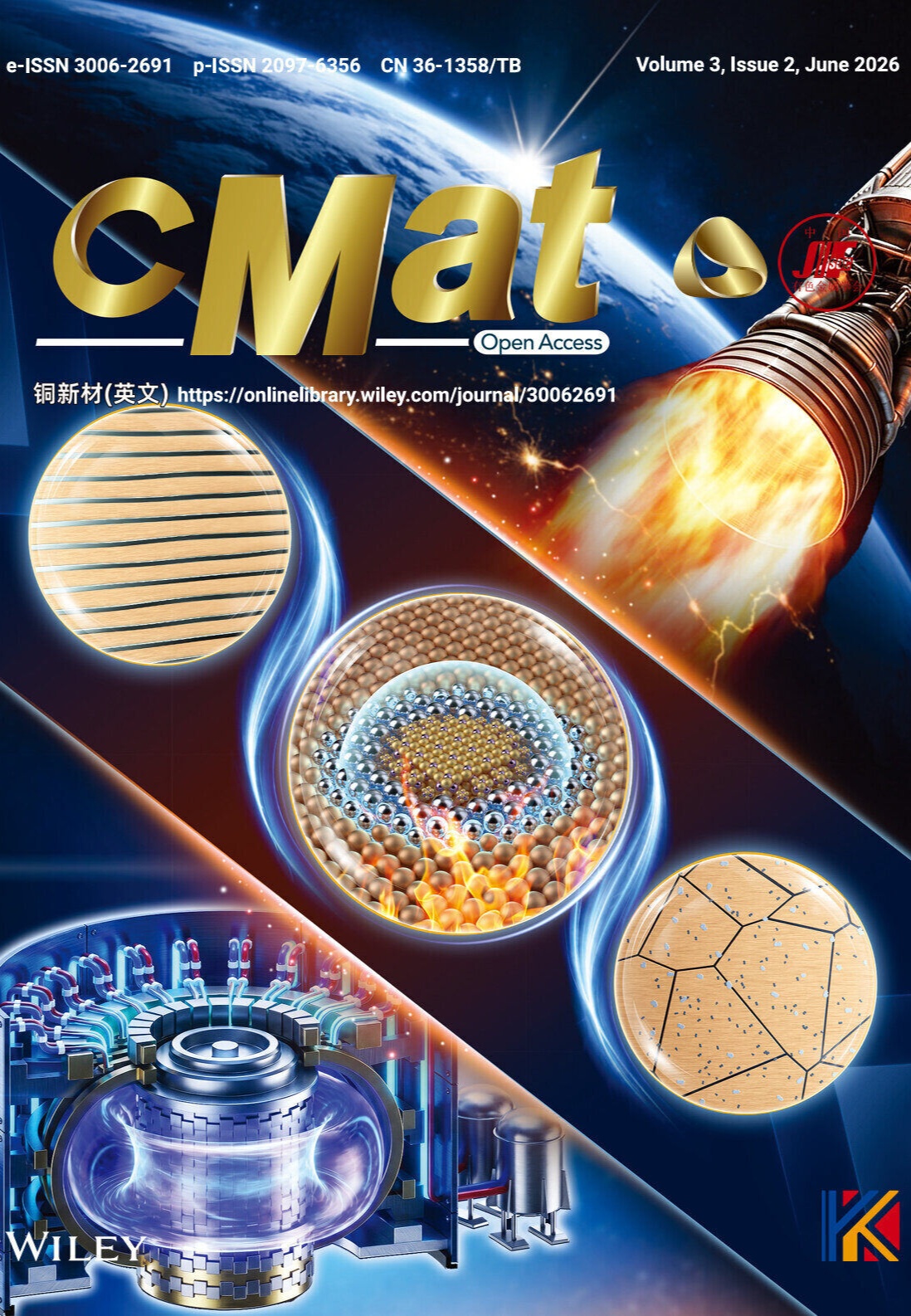
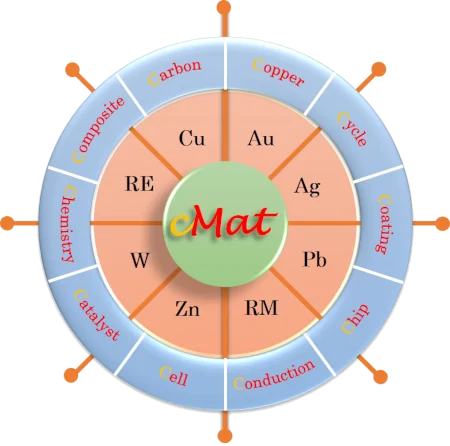
cMat is a peer-reviewed, international and interdisciplinary research journal that focuses on the cross-integration of materials (including metallurgy), minerals, geology, chemistry, and other fields related to the research of copper, gold, rare earth, silver, lead, zinc, tungsten, and rare metals. Its critical focus areas is the innovative development mode of emerging cutting-edge technologies in the fields of mining, milling and metallurgy, such as metaverse, artificial intelligence, computer simulation and process simulation, as well as the latest scientific research achievements and applications of copper-related advanced materials in aerospace (such as superalloy), energy (such as catalyst in energy conversion and storage), nanotechnology (such as nanomaterials), biomedicine (such as antimicrobial agent), electronics (such as superconductor and semiconductor), supramolecular chemistry (such as Cu ion as ligand), etc. cMat publishes high quality articles of the frontier crossing fields related to copper, chemistry, composite, catalyst, cycle, conduction, cell, chip, carbon, coating, etc., and new materials. cMat aims to become a domestic and international first-class science and technology journal in copper related fields. It is committed to creating a cutting-edge, open, and innovative academic platform integrating science and engineering, providing a research result display platform for researchers in relevant universities, research institutions and front-line R&D personnel. Readership: Materials scientists, chemists, metallurgist, physicists, nanotechnology experts, biologist and analytical scientists, engineers from academia and industry as well as policy makers.

More ↓

Impact of Native Oxides on Bonding Interface Microstructure in Deformation-Based Solid-State Additive Manufacturing

In solid-state metal additive manufacturing, oxide removal is crucial for high-quality bonding, yet its impact remains unclear. In the article, the influence of oxides on the bonding interface by using cold spray additive manufacturing and leveraging diverse deformation mechanisms of high-entropy alloys is revealed. Advanced microstructure characterization shows that oxide fragmentation drives grain refinement via lattice rotation and substructure formation. As grain refinement progresses, oxide fragmentation increases metal-to-metal contact, promoting metallurgical bonding. These findings offer deep insights into the role of native oxides at the bonding interface and provide guidance for optimizing bond quality in solid-state additive manufacturing.

Show more

Light Weight High Entropy Alloys: Structure, Properties, and Applications

Lightweight high entropy alloys (LWHEAs), characterized by their low density, exceptional mechanical properties, and superior corrosion resistance, have gained significant attention in materials science. These alloys exhibit promising potential for applications in cutting-edge fields such as aerospace, automotive manufacturing, and energy storage. This paper provides a comprehensive review of recent advancements in LWHEAs research, with a focus on density-based classification methods, distinctive crystal structures, mechanical performance at ambient and elevated temperatures, complex deformation mechanisms, and excellent oxidation resistance. Additionally, the paper explores the diverse applications of LWHEAs in structural, functional, and energy-related materials. Key challenges in current research are highlighted, particularly concerning composition design and performance stability. Finally, the paper outlines future research directions, emphasizing the integration of theoretical modeling, experimental studies, and practical applications to drive technological innovation and facilitate the widespread engineering applications of LWHEAs.

Show more

C-ECAP-Extended Extrusion of High-Strength and Toughness Copper Bar Microstructure Rheology and Performance Regulation

The uniformity of the flow structure of the extruded copper bars has a significant impact on the mechanical and electrical conductivity properties of the material. A finite element simulation was conducted on the continuous equal-channel angular extrusion (C-ECAP)—extended extrusion process of pure copper. The material rheology during the deformation process was studied through experiments, and the variation laws of strain hardening and mechanical anisotropy were analyzed. The results show that the ultra-fine grain structure formed by C-ECAP can effectively suppress the turbulence of the material in the expansion zone and form a polycrystalline structure in the retarding zone. The texture type in the expansion zone is mainly {110}<112> brass texture and {110}<110> Goss texture; annealing twins and {001}<100> cubic weaves appear in the central region; and {110}<100> Goss texture and {110}<111> texture appear in the extrusion region. After deformation, the grain size of the copper bars gradually increases from the center to the periphery, the hardness of the copper busbar decreases first and then slowly increases along the extrusion direction, and the electrical conductivity continues to increase. The texture features, strain state, and expansion chamber structure are the main reasons for the non-uniform flow and anisotropy of the material.

Show more
xiazailiang-0

Light Weight High Entropy Alloys: Structure, Properties, and Applications

Lightweight high entropy alloys (LWHEAs), characterized by their low density, exceptional mechanical properties, and superior corrosion resistance, have gained significant attention in materials science. These alloys exhibit promising potential for applications in cutting-edge fields such as aerospace, automotive manufacturing, and energy storage. This paper provides a comprehensive review of recent advancements in LWHEAs research, with a focus on density-based classification methods, distinctive crystal structures, mechanical performance at ambient and elevated temperatures, complex deformation mechanisms, and excellent oxidation resistance. Additionally, the paper explores the diverse applications of LWHEAs in structural, functional, and energy-related materials. Key challenges in current research are highlighted, particularly concerning composition design and performance stability. Finally, the paper outlines future research directions, emphasizing the integration of theoretical modeling, experimental studies, and practical applications to drive technological innovation and facilitate the widespread engineering applications of LWHEAs.

Show more
xiazailiang-0

C-ECAP-Extended Extrusion of High-Strength and Toughness Copper Bar Microstructure Rheology and Performance Regulation

The uniformity of the flow structure of the extruded copper bars has a significant impact on the mechanical and electrical conductivity properties of the material. A finite element simulation was conducted on the continuous equal-channel angular extrusion (C-ECAP)—extended extrusion process of pure copper. The material rheology during the deformation process was studied through experiments, and the variation laws of strain hardening and mechanical anisotropy were analyzed. The results show that the ultra-fine grain structure formed by C-ECAP can effectively suppress the turbulence of the material in the expansion zone and form a polycrystalline structure in the retarding zone. The texture type in the expansion zone is mainly {110}<112> brass texture and {110}<110> Goss texture; annealing twins and {001}<100> cubic weaves appear in the central region; and {110}<100> Goss texture and {110}<111> texture appear in the extrusion region. After deformation, the grain size of the copper bars gradually increases from the center to the periphery, the hardness of the copper busbar decreases first and then slowly increases along the extrusion direction, and the electrical conductivity continues to increase. The texture features, strain state, and expansion chamber structure are the main reasons for the non-uniform flow and anisotropy of the material.

Show more
xiazailiang-0
xiazailiang-0

Light Weight High Entropy Alloys: Structure, Properties, and Applications

Lightweight high entropy alloys (LWHEAs), characterized by their low density, exceptional mechanical properties, and superior corrosion resistance, have gained significant attention in materials science. These alloys exhibit promising potential for applications in cutting-edge fields such as aerospace, automotive manufacturing, and energy storage. This paper provides a comprehensive review of recent advancements in LWHEAs research, with a focus on density-based classification methods, distinctive crystal structures, mechanical performance at ambient and elevated temperatures, complex deformation mechanisms, and excellent oxidation resistance. Additionally, the paper explores the diverse applications of LWHEAs in structural, functional, and energy-related materials. Key challenges in current research are highlighted, particularly concerning composition design and performance stability. Finally, the paper outlines future research directions, emphasizing the integration of theoretical modeling, experimental studies, and practical applications to drive technological innovation and facilitate the widespread engineering applications of LWHEAs.

Show more
xiazailiang-0

C-ECAP-Extended Extrusion of High-Strength and Toughness Copper Bar Microstructure Rheology and Performance Regulation

The uniformity of the flow structure of the extruded copper bars has a significant impact on the mechanical and electrical conductivity properties of the material. A finite element simulation was conducted on the continuous equal-channel angular extrusion (C-ECAP)—extended extrusion process of pure copper. The material rheology during the deformation process was studied through experiments, and the variation laws of strain hardening and mechanical anisotropy were analyzed. The results show that the ultra-fine grain structure formed by C-ECAP can effectively suppress the turbulence of the material in the expansion zone and form a polycrystalline structure in the retarding zone. The texture type in the expansion zone is mainly {110}<112> brass texture and {110}<110> Goss texture; annealing twins and {001}<100> cubic weaves appear in the central region; and {110}<100> Goss texture and {110}<111> texture appear in the extrusion region. After deformation, the grain size of the copper bars gradually increases from the center to the periphery, the hardness of the copper busbar decreases first and then slowly increases along the extrusion direction, and the electrical conductivity continues to increase. The texture features, strain state, and expansion chamber structure are the main reasons for the non-uniform flow and anisotropy of the material.

Show more
xiazailiang-0
Special Collections
View All Collections→